Wednesday, 3 November 2021

MoDiP AUB Student Bursary 2021/2022

Would you like to be the next MoDiP AUB Student Creative?
Fancy the opportunity to get up close and personal with a museum collection?
Want to see your work on display and inspire others?
Well, here’s your chance…

(We welcome applications from all disciplines.)


Some examples of the work from past creatives:


Adrian Finn, BA (Hons) Architecture, MoDiP Student Creative 2016/2017


For more information see below or contact modip@aub.ac.uk


Closing date: Sunday 21st November 2021


MoDiP Student Creative Brief

Introduction
The aim of the MoDiP Student Creative is to offer all students at the AUB an opportunity to create a piece of work inspired by the MoDiP collection. This could be in any discipline with any creative outcome from physical art work to film or acting production.

Background
MoDiP is the only accredited museum in the UK with a focus on plastics. It is the UK's leading resource for the study and interpretation of design in plastics. Our mission is to increase understanding and appreciation of the use and significance of plastics in design during the 20th and 21st century.


MoDiP’s purpose is to collect, research, interpret and present artefacts made of, or including components of, plastics, and thus add unique value to the Arts University Bournemouth as a learning resource, a resource for collaborative, experimental and interdisciplinary research, and as a gateway to the AUB’s wider environment.

Outcomes
The outcome of this project can be within any discipline working with any material but the work must be inspired by the MoDiP collection or its processes and working practice and in line with its mission and purpose www.modip.ac.uk/about. Depending on the medium, the work will be displayed in cases in the library and/or featured on all of our social media.


Terms and Conditions

Creative’s work

  • MoDiP and/or its plastics collection should be at the heart of the project

  • The applicant should expect to spend time looking at the collection and/or talking to the MoDiP team

  • The applicant could work in any discipline (they would not have to work in plastics)

  • The applicant should be prepared to have work displayed at the end of the project and to describe how they have been inspired by MoDiP

  • The applicant will need to give regular updates to the MoDiP team on progress (to ensure deadlines will be met and that the work can be physically displayed)


Timescale
The successful applicant will be appointed on Friday 26th November 2021, ready to start their project on Monday 29th November 2021. It is expected that the work will be completed and ready for display on Tuesday 19th April 2021.

Bursary
A £250 bursary (including material costs) will be paid to the successful candidate to facilitate the project. Up to 50% (£125) of the bursary can be claimed during the project as material costs are incurred. The remainder will be paid on completion.

Monitoring and evaluation
The resident will be expected to keep the MoDiP team updated with progress reports on a regular basis (to be agreed). This could be either through email including images, or face-to-face.

It is expected that the candidate will write 3 blog posts during the process – complete with images. The first will be a plan for the work, the second being a progress report, and the third showing the work and an overview of the project.

The experience
We expect you to work in a professional manner, engaging with both the collection and the staff of MoDiP. This is an opportunity to have your work published or displayed within a museum setting.

The project can be included in your portfolio of work to show future employers or clients. It will demonstrate working creatively to a deadline and experience of working with real clients.

Reference
Appointment will be subject to approval and written support from your tutor.

How to Apply
To apply please submit a proposal of 300-500 words with expected outcomes including how you intend to use the collection. Please include images of some of your previous work and the name of your tutor, who we will only contact if you are successful.

Email your application to modip@aub.ac.uk with ‘Student Creative’ in the subject box

Closing date: Sunday 21st November 2021

Interview and an opportunity to show Portfolio: Wednesday 24th November – Friday 26th November 2021 (we will contact you to arrange this).

When we will let you know: Friday 26th November 2021.


If you would like more information or an informal discussion about the project please contact the MoDiP team by email modip@aub.ac.uk


Wednesday, 27 October 2021

Popcorn 26 sunglasses, Patrick Kelly, 1987

We have just put these wonderful Patrick Kelly sunglasses out on display as part of the About Plastics case in the museum.


Image ref:
AIBDC : 008474
Image credit: Katherine Pell


Made in France in the mid to late 1980s, the frames are made from cellulose acetate with acrylic (polymethyl methacrylate) lenses. On either side there are four buttons glued into (not onto) the temples. We have not yet been able to identify the precise material that these are made from (possibly polyester), but I love the colours because they remind me of MoDiP’s logo!


Patrick Kelly showed his first collection in Paris in 1985 and became the first US member of the Chambre Syndicale du Pret-a-Porter des Couturiers et des Createurs de Mode in 1988, France's prestigious association of fashion designers. 


Image ref: Patrick Kelly (1954 – 1990)
Image credit:
https://poba.org/poba_artists/patrick-kelly/


One of his trademarks was to customise his designs with multi-coloured and mismatched buttons, a style he attributed to his grandmother's influence from childhood clothing repairs. MoDiP also has an oversized button pin badge kit in the collection, complete with its original packaging, released by Streamline Industries under licence (refer image below). 


Image ref:
AIBDC : 008555
Image credit: Katherine Pell


Sadly, Kelly's
career only lasted eight seasons through four years, as he tragically died of AIDS-related complications on 1st January 1990, aged 35.
One day we hope to be able to acquire one of his dresses but in the meantime, both of these lovely objects can be viewed online or in person at MoDiP.

Katherine Pell
Collections Officer


Wednesday, 20 October 2021

Object Analysis sessions

As term begins and the Arts University Bournemouth continues to welcome back students, we are beginning to return to some kind of normality. Over the past couple of weeks, we have been having zoom conversations with courses, introducing and reintroducing them to the museum and how they can use the collection, and welcoming small groups of students into our space to explore objects in greater depth. It is so nice to have this activity back on campus.

One session we have been doing over the past few days is that of ‘Object Analysis’ with two costume courses: BA Costume, and BA Performance Design and Film Costume.

In these sessions, students develop skills that enable them to gain information about the objects in front of us. We started the session with an introduction to MoDiP. We then looked at the objects on the table, without picking them up, to see what we could glean from them. Next, we had a quick session on how to handle museum objects, followed by time to explore the objects in more depth to see if that provides additional information. We used an object analysis form which can be found on our website with a series of questions. Those question include:


Function
  • What was the object’s likely purpose?
  • How was it used?
  • Consider size, weight, portability, ergonomics etc
Date
  • When might the object have been made or used?
  • Why do you say this?
Manufacture
  • What is it made of?
  • How was it made?
Audience
  • Who was it made for?
  • Who would have used it?
  • Are they the same?
Appeal
  • What was the appeal of the object?
  • Consider its desirability / aesthetic appeal / use.
Acclaim
  • Has the object won any awards?
  • Can it be attributed to a particular designer or manufacturer?
Significance
  • Does this object demonstrate any significant developments in design or technology?
  • Does it represent changes in social or political attitudes?

The selection of objects.  Image credit: L Dennis 

Each group were asked to select three objects out of the eight that were on the table. I specifically selected objects that might be new to the students but would have tell-tale clues that could lead to further information.


The Cameras

https://www.modip.ac.uk/artefact/aibdc-066571. Image credit: L Dennis

I chose the cameras because I thought that film cameras would not be something that all of the students had encountered. We spoke about what they looked like and what they reminded us of. Suggestions included disposable cameras and waterproof GoPros. They are quite unassuming, simple objects but with a bit more research we found that they were designed by Sebastian Conran for SupaSnaps.


The Shoes

https://www.modip.ac.uk/artefact/aibdc-008116. Image credit: L Dennis

The shoes proved to be an easy identification for most of the groups. They could obviously see that they were shoes without picking them up, they also figured out that they were for use in water and they might have something to do with sports. Despite reading out the label on the box - ‘Algae Green’ - no one clocked that the shoes were particularly interesting because they were made using algae as a feedstock for the plastic material.


The Pink Thing

https://www.modip.ac.uk/artefact/aibdc-007949. Image credit: L Dennis

The pink thing was selected by nearly all of the groups. Without picking it up, for the most part they couldn’t identify its function – the first question on the object analysis form. Without knowing its function, the groups struggled with any of the questions that followed. Once they were able to handle the object they discovered so much more about the ‘pink thing’ because it has a label on the side that contains so much information. It is a bin designed to collect waste chewing gum (rubber) which is then recycled, with the contents, to create more bins and other products.


The cream coloured block

https://www.modip.ac.uk/artefact/phsl-x12-0. Image credit: L Dennis

This block was chosen a couple of times by the students but because it didn’t look very interesting compared to the other things on the table it was overlooked by most. The groups that did choose it discovered there was more to it that meets the eye. They thought it might be old but hadn’t anticipated that it would date from the 1870s and made by Daniel Spill.


The Green Thing

https://www.modip.ac.uk/artefact/phsl-x41. Image credit: L Dennis

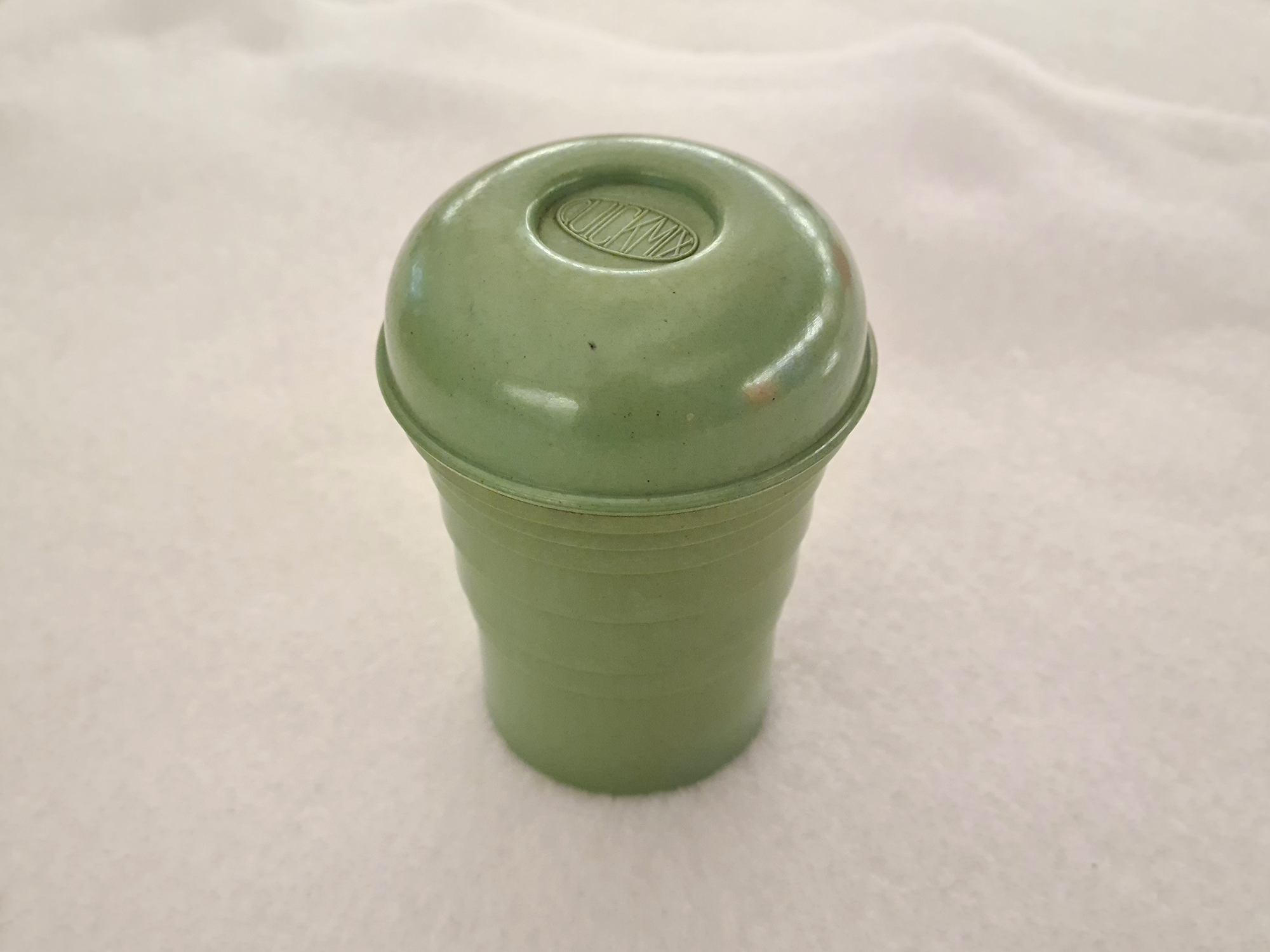
This object caused a little confusion with students seeing that it might be used for mixing something but they didn’t know what it could be. It reminded some of a dog treat toy, others were expecting that it might be squeezed to dispense the contents. It was not until they picked it up that they found it to be made of a very rigid material. They also discovered a patent number and additional information on the base which could have been used to find out more about the design developments that were on display here.


The Bag

https://www.modip.ac.uk/artefact/aibdc-008171. Image credit: L Dennis

The bag was laid down on the table and it wasn’t clear how you would carry it. Once the students started to handle it they found it to be a rucksack or backpack and they could see the continued use of seatbelt material on the back panel. By exploring the catalogue record the students also discovered that the bag itself is made from airbags. We thought about who the bag might appeal to with one group describing some very specific characteristics of the kind of individual who would use it.


The Hat

https://www.modip.ac.uk/artefact/aibdc-008192. Image credit: L Dennis

The helmet looks like a classic steel helmet from the 2nd World War. It is, however, made of phenol formaldehyde and has a lovely moulded inscription showing the manufacturer’s name not seen until it was lifted. The weight of the hat was also a surprise being much lighter than the students had anticipated.


The Cassette

https://www.modip.ac.uk/artefact/aibdc-007911. Image credit: L Dennis

Poor Elkie Brooks. No one chose to look at the cassette. I am not sure if this is because they knew what it was or because they didn’t. I included it because it is full of information that can help to start a thread of research that will tell us more about the object itself, as well as the time period it has come from.


These sessions help participants to foster research skills into objects. If you would like to bring a group to explore objects in MoDiP, whether you are part of the AUB or not, please do get in touch.

Louise Dennis, Curator of MoDiP

Wednesday, 13 October 2021

AUB Materials Library

As you may know MoDiP is situated in the AUB Library, what you might not know about is another fantastic resource that resides in same building, the Materials Library https://aub-uk.libguides.com/collectionspages/materialslibrary 

The Materials Library. Image credit: Louise Dennis

You can find out more information by scanning the samples. Image credit: Louise Dennis

The drawers of intrigue.  Image credit: Louise Dennis

The AUB Materials Library is a collection of new and innovative product samples including ceramics, plastics, glass, paper, metal, timber and much more.  The purpose of the collection is to inspire and offer ideas in support of creative practice, as well as providing a knowledge of materials, their properties and applications. Each material sample in the Library features a unique QR code that can be scanned into the software. Scanning the QR code opens an information data sheet for the material, including its location within the Materials Library and links to the manufacturer’s website.

A few of the materials samples. Image credit: Louise Dennis
 
A glittery acyrlic sample.  Image credit: Louise Dennis

A selection of samples. Image credit: Louise Dennis

It is easy to get lost down a rabbit hole of curiosity just by pulling open a drawer and having a rummage.  For obvious reasons I gravitate towards the plastics materials but you soon drift away to something else.  If you are visiting MoDiP, I would heartily recommend a wander to the far corner of the ground floor of the building and having an explore.  

Louise Dennis, Curator of MoDiP

Wednesday, 6 October 2021

Telescopic water suit, Martin White, 1937.

This bright, cherry red swimsuit never fails to make me smile and it is one of my favourite objects from our current exhibition, Beside the sea. It was designed by Martin White in 1937 as a ‘telescopic’, one-size-fits-all, swimming costume, which is essentially achieved by shirring with an elasticated thread on the sides and rear (refer detailed image on the right, below). 


Martin White telescopic swimsuit, AIBDC : 008463
Image credit: MoDiP


Versatile in its styling, the swimsuit could be worn in various ways, as illustrated by the 1951 advert from the film magazine, ‘Picturegoer’, below right. 


The fabrics used in early swimwear were commonly dark coloured, as this was considered less revealing when wet, and predominantly made of natural but restrictive materials such as wool, which could provide some stretch but was particularly heavy and uncomfortable when wet. As swimming as a sport and sea bathing as a leisure activity became more popular, there was demand for improved fit and practicality in the associated clothing. Influenced by mainstream fashion, changing societal attitudes to body exposure and advancements in synthetic textile technology, designs became smaller and more streamlined. 

Lastex™, first released in 1931, helped to revolutionise swimwear. An elastic yarn consisting of an extruded rubber core covered in cotton, rayon, wool or silk thread, Lastex™ could be knitted or woven into a variety of fabrics to produce one-way or two-way stretch, depending upon how it was used. It enabled the mass production of lightweight garments that would mould to the body, providing fit, freedom and control, first appearing in corsetry. 


Sears catalogue, 1932.
Image credit:
https://witness2fashion.wordpress.com/2015/03/19/changing-the-foundations-of-fashion-1929-to-1934/#comments


In 1937, the British swimwear company Martin White utilised the Lastex™ thread on its own to create shirring in their telescopic water suit. The patent, filed by Jack French White the year before (refer image below), shows how this was realised. Proposing the use of a material with little or no inherent stretch, the elasticated thread would be inserted into the fabric in widely spaced intervals and in two directions, at right angles to each other. Applied in tension, once released the fabric would draw up into a honeycomb structure, resembling smocking. It was suggested that cutting or fashioning a garment into a large number of sizes and fittings would no longer be necessary as this method would achieve a one-size-fits-all form. 


Illustration of how Martin White proposed to use Lastex™ yarn in forming the telescopic swimsuit.
Image ref:
https://patentimages.storage.googleapis.com/87/f1/0e/7c3211d7deb436/US2134630.pdf


Other manufacturers also adopted Lastex™ in a variety of ways, as can be seen in the 1952 advert below, although it was not long before this innovative yarn was superseded. Lycra™, available from the 1960s, was a lightweight polyurethane elastomeric fibre that provided four times the stretch as well as enhanced resistance to oxidation and oil. Lastex™ had been found to lose elasticity as the rubber deteriorated from UV exposure and/or through contact with the chemicals found in suntan lotion and chlorine. 


A range of swimwear manufacturers also used
Lastex™ in their designs.
Image credit:
https://i.pinimg.com/originals/54/6b/02/546b02ea8f0840c1bc2373e9d34ed312.jpg


Luckily, MoDiP’s example is in a very good condition and I particularly love the low cut back, removable straps and side cut-outs that all reflect the trend for sunbathing that was fashionable at that time. 


Martin White telescopic swimsuit, AIBDC : 008463
Image credit: MoDiP


And finally, a glamorous 1946 film clip advertising some of Martin White’s latest telescopic swimwear designs. Note the first two-piece has a rather attractive wrap-over pareo (pāreu) skirt in white plastic! 


You can view the Martin White swimsuit and many more objects exploring the subject of plastics Beside the sea until 3rd December 2021.

Katherine Pell 
Collections Officer

Wednesday, 29 September 2021

Plastic Vanitas, Mariele Neudecker, 2015

Six years ago, MoDiP hosted an international conference called Provocative Plastics, which took place over two days at the Arts University Bournemouth to explore the past, present and future potential of plastics. At the same time, we had an exhibition of photographs on display in TheGallery by Mariele Neudecker, to compliment the conference: Plastic Vanitas


Plastic Vanitas on display at TheGallery
Image credit: TheGallery

The basic premise of the project was to re-present the MoDiP collection as a series of Vanitas paintings. Vanitas was a specific form of Dutch still-life painting that became increasingly popular in the 17th century. Compositions included objects that carried symbolic meaning, such as a clock representing the passing of time, jewellery indicating wealth and food/wine alluding to pleasure. All of these would build up an overall moral message: the vanities of life are fleeting and, since death is inevitable, we should live our lives in the moment, as fully as possible.


One bay of shelving in the MoDiP store.
Image credit: MoDiP


Mariele had the opportunity to go behind the scenes at MoDiP and discover the collections for herself, removing boxes from the shelves at random and unwrapping the objects within them to see what they were. She became interested by how the objects were actually stored: by material, size and weight (heavy boxes on the bottom of the shelving and lighter ones at the top), in accumulations of objects that often make no intellectual sense.

To explore this further, she decided to ask the MoDiP team to identify potential objects that could represent the symbolism she was looking for. She would then take the entire box that each object was stored in and use all of the other items within (previously unseen by her) to form part of the still-life. The work was created in the Arts University Bournemouth's photographic studios with assistance from a team of students studying BA (Hons) Photography and BA (Hons) Commercial Photography.

In the artist's words:

I wouldn't call myself a photographer. I use photography but it's usually outdoors and photographing what's there, rather than setting up scenes like this. I'm learning loads about lighting etc. It's really fun how each student has their own tricks up their sleeve, which they're happy to share.

Mariele Neudecker


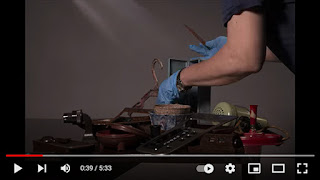
One student, Julio del Castello Vivero, recorded his experience as a time lapse animated film showing the process of the objects being unwrapped, positioned, lit and then photographed (refer below).


Julio del Castello Vivero’s animated film
Image credit:
https://www.youtube.com/watch?v=pZrlTRxRR5E


In total, Neudecker produced 49 photographic artworks that she has subsequently toured around the world. We have a selection on permanent display outside the museum, on the first floor of the AUB Library. Here are two of my favourites:


Still Life with Lemon and Apples - (the contents of Box 653).
Image credit: Mariele Neudecker


Still Life with Thermos jug and Door Handle - (the contents of Box 316).
Image credit: Mariele Neudecker


In remembrance of Leo Gauvain, seen in the image below on the left, smiling (he was always smiling) with Julio del Castello Vivero, myself and Pam Langdown.


Setting out objects in the AUB photography studio.
Image credit: Louise Dennis

Katherine Pell
Collections Officer

Wednesday, 22 September 2021

Beside the sea - introduction

In the video below I introduce our current exhibition, Beside the sea.  This is the first in a series of short videos all about the objects we have on display.

Louise Dennis, Curator of MoDiP