Showing posts with label Collection Care. Show all posts

Wednesday, 7 September 2022

British Armed Forces NAAFI tokens

MoDiP has three different examples of plastics NAAFI tokens in the collection. With reference to the image below, on the left is a circular ½ d token, in the centre an octagonal ½ franc token and on the right, a circular green coloured token valid in NAAFI Egypt only.


MoDiP’s three NAAFI tokens.
Image credit: Katherine Pell


Established in 1920, the NAAFI (Navy, Army and Air Force Institutes) was an amalgamation of earlier organisations that had essentially been set up to feed the British Armed Forces. Administering all three services, by 1944 it was supporting military deployment through the provision of canteens, bars and shops, as well as controlling entertainment (ENSA) and leisure activities. Metal, paper and subsequently plastics tokens were all utilised, aiding the NAAFI by assisting with the organisation of supplies, controlling spending, preventing issues with local currency exchange, and avoiding the need to transport and deliver large amounts of heavy coinage.


AIBDC : 009324
Image credit: Katherine Pell


MoDiP’s first two tokens (refer images above and below) are made of the same material, although we are not exactly sure what that is! I have seen examples of these tokens variously described as: compressed paper, plastic, laminated plastic, wood, cardboard, bakelite, fibre and formica. Our guess is that it is a composite comprising a synthetic resin (possibly phenolic) bonded to either paper or fabric, hence the visible texture. The tokens are lightweight but strong and rigid, durable and water resistant. We are hoping to have them tested using FTIR (Fourier Transform Infrared Spectroscopy) soon, through which we hope to get a more definitive answer.
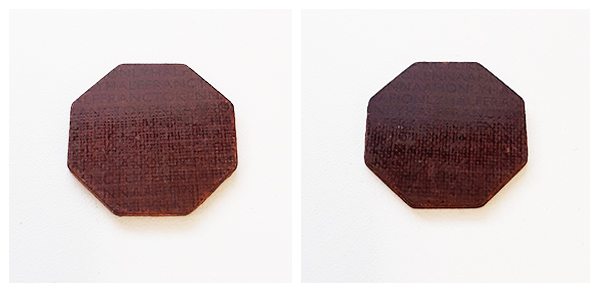

AIBDC : 009325
Image credit: Katherine Pell


We have dated the ½ d token to 1939-1945 but can be more specific for the ½ franc token based on information taken from ‘Over to You’, the official news sheet of the 5th Battalion Coldstream Guards (refer below). Edward Hallett, from his blog Tales from the Supply Depot, has published an excerpt dated 10th July 1944, that reports the introduction of the octagonal token as follows:


Excerpt from ‘Over to You’ news sheet, 10th July 1944.
Image credit: https://talesfromthesupplydepot.blog/2018/09/22/1-2-franc-n-a-a-f-i-token/

A full transcript of the entire daily news sheet can be found here.


AIBDC : 009322
Image credit: Katherine Pell


With regard the NAAFI Egypt token (refer image above), I found the following contribution written by P.R. Bertram entitled NAAFI Numismatics, published in ‘The Quarterly Circular’ of the Egypt Study Circle (September Quarter 1993, Volume XV, No. 3).


Excerpt from ‘The Quarterly Circular’, September 1993.
Image credit:
http://www.egyptstudycircle.org.uk/QCs/QC166.pdf  


From this article we can state the manufacturer as British Artid Plastics Ltd with a date of circa 1951-1964. We believe this token was injection moulded in polystyrene (PS) but, again, FTIR will hopefully confirm this.
 
We also have many other types of plastics tokens in the museum, including a variety of Co-operative Society tokens (mainly for bread and milk), transport tokens and another favourite of mine, the British Restaurant tokens. All of these objects can be viewed in the museum on request.

 
Katherine Pell
Collections Officer

 
References:
https://en.numista.com/catalogue/exonumia60141.html
https://katzauction.com/lot/28081
https://naafi.co.uk/history/#:~:text=NAAFI's%20History,world%20for%20over%20100%20years.
https://talesfromthesupplydepot.blog/2018/09/22/1-2-franc-n-a-a-f-i-token/
http://ww2talk.com/index.php?threads/war-diary-5th-battalion-coldstream-guards-jan-dec-1944.33691/page-2
https://www.abccoinsandtokens.com/MT.Y.NF.003.001.html
https://www.alvin-portal.org/alvin/view.jsf?aq=%5B%5B%5D%5D&c=13&aqe=%5B%5D&af=%5B%22COUalpha2_facet%3AGB%22%2C%22CRP_facet%3A1900%22%5D&searchType=OBJECT&pid=alvin-record%3A343417&dswid=-3405
https://www.britishmuseum.org/collection/object/C_2008-4075-4
http://www.egyptstudycircle.org.uk/QCs/QC166.pdf 
https://www.iwm.org.uk/collections/item/object/30059225
https://www.iwm.org.uk/collections/item/object/30057785

Wednesday, 2 June 2021

Jif lemon

When was the last time you saw a Jif lemon for sale in the supermarket? Not the brand’s lemon juice sold in a 250ml glass bottle. Not the modern, yellow, texturised, 100ml plastic bottle with the flat bottom to aid stability. I’m talking about the instantly recognisable container that realistically resembles an actual lemon: a great example of a product which can be identified from the packaging alone.


Image ref: AIBDC : 005918
Image credit: MoDiP


Edward Hack is widely credited as having developed the original idea to package lemon juice in a lemon-shaped container in the early 1950s. He approached Cascelloid Ltd to produce the bottle and presented them with what he considered to be the perfect shaped lemon, on which to base their design. Apparently, he had spent a significant amount of time searching for this elusive fruit, exhausting the supplies of Harrods, Selfridges, Fortnum & Mason as well as the Convent Garden market!


The model was made by Cascelloid’s Chief Plastics Designer, Bill Pugh, who in 1954 hand-carved it in wood, covered with fresh lemon peel. The Edward Hack Ltd. ‘Hax’ lemon juice bottle was one of the earliest applications for blow moulded polyethylene in the food industry.


Image ref: Edward Hack’s Hax lemon juice went on sale in 1954.
Image credit: https://beachpackagingdesign.com/wp-content/uploads/2015/07/HaxLemonAd-1955-2-Color.png


However, as is often the case with new designs and inventions, another plastics lemon container was being developed simultaneously by Stanley Wagner for his company Coldcrops Ltd. Manufactured by Shipton Plastics, it was released to the market a year later in 1955 under the Realemon brand (later ReaLem). Although legal action was taken, the case never reached court due to the fact that both companies were subsequently bought out by Reckitt and Colman in 1956, who launched their Jif lemon juice brand using the packaging originally developed by Hack and Pugh.


Image ref: Jif lemon was sold at chemists, grocers and fishmongers for one shilling.
Image credit: https://www.examinerlive.co.uk/news/uk-world-news/nationwide-hunt-man-who-invented-17809583


Achieving huge success in the UK by linking their product to Shrove Tuesday with the memorable slogan 'Don't forget the pancakes on Jif Lemon day!' (see 1980s TV advert below), Reckitt and Colman also became forever linked to the Jif lemon through a 1990 court case that set the precedent for the law of ‘passing off’ when a competitor tried to sell their lemon juice in very similar packaging. Despite being associated with the product for almost forty years, the business was sold to Unilever in 1995 for $250million. 


Image ref: 'Don't forget the pancakes on Jif Lemon day!', devised by the advertising agency 
Foote, Cone and Belding Ltd.
Image credit: https://www.hatads.org.uk/catalogue/record/578c6a48-094b-4a9e-a54d-bb9402e9b769/ 


By the year 2000, 80,000 lemons were being manufactured every day in the five weeks leading up to Shrove Tuesday, sold at a cost of just 39p each. At some point between 1995 – 2005 the design was altered, resulting in the modern version being slightly smaller with less surface texture, having a flip-top (instead of screw) lid and a slimmer logo that now includes the wording ‘real lemon juice’ beneath. It also includes the LDPE plastics identification code on the opposite side.

MoDiP has examples of both designs in the collection but unfortunately, our two early screw-top lemons are both unwell and currently reside in the hospital cupboard. As you can see from the image below, there is significant discolouration which we assume has been caused by lemon juice residue. We are going to tentatively ‘clean’ this away to see if the actual plastics material has deteriorated as well.


Image ref: MoDiP’s ‘poorly’ lemons.
Image credit: Katherine Pell


In the meantime, our 2015 example is currently on display in the museum and Stuart Bartholomew, one of our MyPlastic exhibition interviewees, evokes nostalgia for this cultural icon during his childhood when fresh lemons were not as widely available as they are today. Reversely, it would now appear that the plastics lemons are becoming scarce as Unilever have confirmed to MoDiP their intention to phase out production.

Katherine Pell
Collections Officer

References:

https://www.atlasobscura.com/articles/plastic-lemons-history-britain-juice

https://beachpackagingdesign.com/boxvox/packaged-past-tense-the-hax-plastic-lemon-pack

https://www.examinerlive.co.uk/news/uk-world-news/nationwide-hunt-man-who-invented-17809583

https://www.facebook.com/UnileverArchives/posts/today-is-shrove-tuesday-better-known-here-in-the-uk-as-pancake-day-since-the-mid/1002987433062074/

https://www.independent.co.uk/news/people/obituary-bill-pugh-1426051.html

https://www.jstor.org/stable/24865638?seq=1

https://www.packagingnews.co.uk/features/history-of-the-world-in-52-packs-8-jif-lemon-03-09-2015

https://tedium.co/2017/02/28/lemon-juice-squeeze-bottles-history/

https://www.thegrocer.co.uk/unchanged-pricing-one-year-on-for-that-jif-lemon-for-shrove/58446.article

https://en.wikipedia.org/wiki/Jif_(lemon_juice) 

Wednesday, 13 January 2021

Horn combs

The museum recently (pre-covid) took receipt of a selection of 139 horn combs, acquired by the Worshipful Company of Horners to be accessioned into their collection, which has been cared for by MoDiP since 2010.

Horn has been used since prehistoric times as a cheap, readily available, easily worked material from which essential tools, as well as decorative items, were made. It is considered to be one of nature's plastics because of the way in which it can be moulded with the application of heat and/or pressure. The Horners’ collection provides a comprehensive insight into the use of this material up to the development of the early synthetic plastics which replaced it.

MoDiP’s Documentation Officer first completed the object entry process: listing each comb within the museum’s Accession register, ascribing a unique number and then labelling the objects and finally, producing a searchable catalogue record within MoDiP’s collections database. Once all of the data had been captured, the combs were handed over to me for storage.

After an initial assessment of the size and variation of the objects as well as the shelving space that had been set aside, I ordered some ‘Really Useful’ boxes, matching those already being used to house this particular material. Being made of strong and inert polypropylene, these boxes also stack easily and are transparent so that the contents can be viewed easily. 

Image ref: Preparing the storage boxes in the museum.
Image credit: Katherine Pell


Each box had to be lined with plastazote, a chemically stable, polyethylene foam cushioning material. We buy this in very large sheets and I was able to make use of the museum space, during quiet periods, to spread out all of the equipment I needed to cut it to size (see image above). I typically use a ruler, scalpel and cutting mat for this but am thinking about investing in a thermocutter hot knife tool – it would certainly have made this job a lot easier!

Next, the combs were sorted so that similar types could be stored together. This is advantageous for minimising future handling; if a researcher wanted to look at all of the mourning combs for example, it is much easier to retrieve one box containing them all than to search for and then remove ten different objects from ten different boxes. It is also beneficial to keep similar materials together; several combs contain silver which require regular condition checking - far simpler to achieve if they are all located in the same box and maintaining specific environmental micro-climates becomes much more straightforward too.


Image ref: The combs all sorted into boxes.
Image credit: Katherine Pell


Finally, each box was then divided up into sections with further plastazote being used to separate, support and cushion each comb (see image below). 


Image ref: A box of hair pins, sorted (left) and then stored (right).
Image credit: Katherine Pell


The boxes were then numbered, positioned on a shelf on the roller racking in the store and each comb’s catalogue record updated with a location reference so that they can be identified. The next job is photography, which we hope to begin soon, and then the records will be made available to search online through MoDiP’s website.


Image ref: Boxes numbered and located on a shelf in the store.
Image credit: Katherine Pell


There are some really lovely examples in this collection but my favourites are the painted combs, particularly the bird and the butterfly (see image below). Made in China in the mid twentieth century, they are both translucent horn, shaped specifically to incorporate the beautiful hand painted design.

Image ref: The painted combs.
Image credit: Katherine Pell


All of these objects, along with the rest of the Worshipful Company of Horners’ collection, can be viewed in the museum by request once we are able to re-open.

Katherine Pell
Collections Officer

Wednesday, 20 May 2020

New Art Fund Grant for MoDiP

We are pleased to announce that in our role as convener of the Plastics SSN (PSSN), and jointly with the Dress and Textiles Specialists (DATS), we have been successful with our grant application for MoDiP for £14,500 towards Art Fund’s ‘Network grants’ scheme. The project runs from May 2020 to April 2022.

Detail from a dress made from a flocked but unspecified synthetic material. 
It is typical of the kind of objects the project will enable us to research.

The grant is for creating a resource that will share research, promote best practice, and build museum staff skills and confidence in a significant but neglected subject area: garments made from synthetic materials for example viscose, Terylene™ and Lycra™. Its purpose is to equip museum staff with the knowledge and confidence to engage the public with these collections. The partnership will combine expertise in traditional state-of-the-art curatorial care for garments with an understanding of the complex needs of this materials group.

The project has three components:
  • Sharing of recent research, knowledge and good practice relating to synthetic garments at four expert workshops at museums with complementary collections.
  • Co-development of a unique online toolkit based on information gathered at the workshops.  
  •  Two workshops for grassroots members of both networks to introduce the toolkit and provide evaluation.

The expert workshops will be small, focused and participatory. Each will take the same format with two 30 minute presentations, one by a guest speaker sharing specialist expertise and the other by the curator focused on issues raised by the host's collection. These will be followed by in depth discussions of at least 10 objects, sourced from the hosts’ and delegates' collections, in real or digital form, depending on their vulnerability. Discussion, led by each object's curator, will focus on care, preventive conservation, documentation and interpretation.

Detail of another dress made with unidentified synthetic material.

The toolkit will bring together a collection of 40 objects selected from those discussed, supplemented as necessary to provide a balanced representation of the subject from high fashion to sportswear.  Versions of the toolkit will be available both on the DATS website: https://www.dressandtextilespecialists.org.uk/ and on the PSSN microsite: https://www.modip.ac.uk/projects/plastics-ssn.

The grassroots workshops will provide supportive training environments for members of both networks. As well as providing a CPD opportunity, especially for those who prefer a more active method of engagement, the workshops will provide evaluation on the prototype toolkit.

The application was submitted just before the full impact of Covid-19 was completely apparent. Our original intention was to hold the workshops at four venues across the country at three-month intervals starting in the autumn. However with museums now closed for the foreseeable future this schedule may need to be revised. This project is centred on people getting together, looking closely at museum objects and discussing them face-to-face. It is hard to see quite how else we can make it work, however, as we are still six months away from when we hoped to hold the first workshop, maybe by then ‘a new normal’ will have been created which will make it feasible. 

Detail of a skirt made from 35% polyester and 65% polyurethane. 
It is unusual to know so much about the material. Research into the object may help us learn more about other less well documented objects in the collection.

We would like to thank the Art Fund. Their aim network grants  provide funding to support Subject Specialist Networks (SSNs) in sharing expertise across the museum sector, for the benefit of collections and audiences.  The process has been refreshingly straightforward with staff members on hand throughout the process to discuss the application and provide advice.  We would also like to take this opportunity to encourage anyone who is interested in being involved with the project to get in touch by emailing modip@aub.ac.uk.

Professor Susan Lambert, Chief Curator, MoDiP

Wednesday, 6 May 2020

Closing the museum for lockdown

On receiving notice that the AUB campus would be closing from 5pm on Friday 20th March 2020, in line with the Government’s country-wide lockdown for COVID-19the MoDiP team had only a few days to get the museum organised. We had just completed the installation of our latest exhibition, Being me: plastics and the body, which had not even been opened to visitors at that point.  
The first task was to remove from display any vulnerable plasticsie. objects made from cellulose nitratecellulose acetatepolyvinyl chloridepolyurethane, or any of the rubber-based plastics like gutta percha. This left several empty shelves in the display cases (see image below). 

Image credit: MoDiP Image reference: Gaps in the plastics timeline of our About Plastics display.

The next job was to remove any objects on display in the tank cases, situated outside the museum, within the AUB library. This was important because this space is not environmentally controlled for the museum objects (which is why we limit object display time here). The temperature and humidity are determined by the heating within the library - which would be turned off for the duration - and even though overhead lighting would not be a problem (also turned off), there is still natural sunlight coming into the space. 

Image credit: MoDiP Image reference: Empty cases in the library corridor. 

Within the museum, any objects on display that are particularly fragile were then either returned to their storage locations or wrapped and supported with acid-free tissue paper in situ. At that stage we had no idea how long the lockdown would continue for.

Image credit: MoDiP Image reference: Objects wrapped in acid-free tissue paper in the display cases. 

Finally, any objects being worked on that did not yet have a permanent storage location needed to be covered, again using acid-free tissue paper. This provides protection from dust and is a barrier against potential deterioration due to the effects of temperature, humidity and light etc.

Image credit: MoDiP Image reference: Objects in the store, wrapped in acid-free tissue paper. 

When all this was completed, we said goodbye to the objects (and each other), unplugged the computers, turned off the lights, locked the door and, rather anxiously, left the building. 

Since then the MoDiP team have all been very busy working from home, maintaining the museum’s online presence and keeping in touch through virtual meetings (I love to see inside everyone’s houses). 

I have been allowed access into the museum for one hour at the beginning of each month in order to check over everything and to download the readings from our data loggers (the Home Office have confirmed this is permissible and huge thanks to the AUB Facilities and Security team for making this possible) 

Whilst our objects are quite familiar with being left in a dark, stable environment for long periodsit is important to check that all of the monitoring systems are working properly and that there are no problemsGoing into the empty museum has been an unusual experience but we are currently formulating plans to re-open safely when restrictions are eased. Until then, stay safe and hope to see you again soon. 

Image credit: https://www.modip.ac.uk/artefact/aibdc-0015212 Image reference: Keep smiling. 

Katherine Pell, Collections Officer.