Showing posts with label Guest Blogger. Show all posts

Wednesday, 7 June 2023

Playing Well with LEGO

On a recent trip to the Museum of Design in Plastics, I was reminded of my first visit to LEGO headquarters in Billund, Denmark. I have been lucky enough to work with LEGO over the past eight years, producing games for their new LEGO sets. My first project was updating the mobile game LEGO City for the Christmas 2017 season, and the development team from Amuzo in Bournemouth got to visit LEGO HQ to see the toys before they were in the shops.

As if getting to play with “secret” LEGO was not exciting enough, our LEGO Company contact asked if we would like a visit to the LEGO Museum, and the mythical LEGO archives, of course it was an unanimous “Yes please!”


The LEGO Museum, formally the Christiansen family
home and carpentry workshop in Billund, Denmark
Image credit: Nick Roberts


The LEGO Museum in Billund is actually the original house and workshop that Ole Kirk Christiansen, the founder of LEGO, lived in with his family from 1916. He was a carpenter, making tables and chairs, before a lack of orders through the Great Depression forced a business rethink. On 10th August 1932 the workshop was dedicated to making wooden toys.

Christiansen continued to struggle in business, enjoying a brief period of success with yo-yos, setting his staff to making the two yo-yo halves in bulk. When the yo-yo market also dried up and left him with many circular wooden pieces, he needed an idea to use them up – wheels. The carpenters set about making pull-along trucks, cars and animals. These proved more popular. One of the first toys was a wooden pull-along duck – and there it was, sitting in a glass case in front of me.


Early wooden toys created by the Christiansen workshop before discovering plastic.

Image credit: Nick Roberts


Toys were the future for the Christiansen family, and they held a staff competition in 1934 to come up with a new company name. The winner was “LEGO” – derived from Leg Godt, Danish for “play well”.

It was an overseas business trip by Ole Kirk’s son Godtfred in 1947 that would set LEGO on a pathway to global domination of the plastic toy market. They had recently purchased one of the first plastic moulding machines. The first plastic tests LEGO tried were small teddy bear figures, mainly because this was the mould that came with the machine! The definition in the plastic was a delight. Godtfred realised that this was the future of toys – products that could be designed and mass produced, each one identical to the last. No more carving wooden ducks for LEGO. But the toy buying public still preferred wooden and metal toys. LEGO needed a new product.


The first tests in plastic for a fledgling LEGO company – small teddy bears
were a mould that came with their first plastic moulding machine.
Image credit: Nick Roberts


Building sets of trucks and houses made of plastic were already on the market, but sold as individual toys that were incompatible with each other. Godtfred had a conversation with a buyer that inspired him to turn the building sets into a LEGO System, made up of building bricks that were reusable and universal. Small plastic bricks that could be mass produced in multiple colours, then sold in sets – the beginnings of LEGO as we know it today. Indeed, the early LEGO building sets proved very popular, there was just one thing that was not quite right – the bricks did not ‘click’ together. A light breeze, or disgruntled little brother, could easily send a LEGO building tumbling to the floor. There had to be a solution.


An early LEGO system set, before the locking LEGO brick was invented.
Image credit: Nick Roberts


The boffins at LEGO knew that somehow they had to make a LEGO brick that would hold firm when attached to another, but also be able to disconnect to allow the child to make a new model when they chose. Many experiments took place on the best way of connecting the bricks – dots in the plastic, criss-cross patterns, studs and holes, tiny pinhead connectors. Eventually they settled on the classic circle and stud pattern LEGO 8-stud brick we know today, a design that is simple but very effective, and went on to be the foundation of every LEGO set since. As that is the joy of LEGO, any set will connect to any other set. The minifigure people will always slot their feet onto the LEGO studs and stand proud.


The experiments the LEGO company did into lockable building bricks,
eventually patenting them all to stop the competition stealing their idea.
Image credit: Nick Roberts


LEGO were savvy though – not only did they patent the 8-stud brick, but they also patented all of their other experiments, to keep the competition from copying their building brick idea. LEGO sets would soon dominate toy shops all over the world.

So what about that LEGO archive I teased you with? What a treat and privilege it was to visit. Underneath the LEGO Museum is a basement hidden from public view. Large metal shelves are all crammed together, but turning a giant handle moves the shelves along, revealing each year of LEGO toys from 1950 to the present day. The kid in me took over and I was soon holding the LEGO Circus Train set I had for Christmas 1988 in my hands!

Nick Roberts, 28th April 2023

Wednesday, 10 November 2021

Gardening in Miniature

Originally posted on 12/05/2018 by the Gardens Trust on their blog. Reproduced here in edited form with kind permission from Dr David Marsh, the author and a trustee of the Gardens Trust.


Sorry to disappoint you if you thought you were going read a post about gardens in bottles, on saucers, mini-flower pots or bonsai. Instead it’s a potential walk down Memory Lane for everyone who grew up between the wars and had their first chance to turn their hands to gardening. But not the hard way. You didn’t have to get your fingers dirty, you didn’t have to do any backbreaking digging or weeding. You didn’t have to deal with marauding slugs and snails, your plants didn’t get munched by greedy caterpillars and you didn’t have to encounter any stinging or biting bugs or noxious plant diseases. Indeed, you could garden on the kitchen table or on your bedroom floor.

The opportunities stopped during the war when you really did have to dig for Victory, but started up again for another generation in the 1960s and 70s, although once again it didn’t last that long.

How come all this gardening the easy and blisterless way was possible? It was originally all thanks to a man named William Britain whose company created the first mass-produced models that allowed children (and consenting adults!) to create a miniature version of their parents’ back gardens and to rearrange it all at will.


A gardener with his barrow from the Britains Miniature Gardening range, c. 1930s.
Image credit: https://www.lilliputworld.co.uk/collections/garden/products/britains-man-with-wheelbarrow-white-shirt


William Britain (1828 – 1906) was a Midlands metal worker who moved to North London in 1847 to work as a ‘brass clock maker’. By the 1880s he had started to manufacture a range of clockwork metal toys and a decade later, turned his attention to the toy soldier market, then largely dominated by German imports. In 1893 his eldest son, William Britain Junior (1860 – 1933), invented a new production process of hollowcasting in lead which enabled the company to both increase their output and sell their figures at a lower price than their competitors. W. Britain was soon established as a household name for toy military figures.


Foreward to a 1958 Britains company catalogue.
Image credit: https://www.brightontoymuseum.co.uk/w/images/William_Britain,_1828-1906_(Britains_1958).jpg


The horrific effects of World War I saw demand for toy soldiers decline dramatically and to stay in business, Britain’s responded by increasing its ‘domestic’ and ‘civilian’ ranges. In 1921 they introduced their Model Farm, which was quickly followed by their Zoo. Over the next few years they added more and more new lines: emergency services, horse racing, circuses, cars and road traffic and, lest you think I’ve forgotten the topic of this blog, in 1930 they began Britains Miniature Gardens


I should explain at this point, just in case you think my punctuation is a bit awry, that the company name had what Brighton Toy Museum call “a roving apostrophe”, as its name changed from W. Britain to Britain’s to Britains’ when there were more than one member of the family running it, before eventually settling on Britains without any apostrophe at all!

Miniature Gardens were, according to the sales catalogue, designed to enable “the gardener, amateur or professional, to plan out his garden in a thoroughly practical manner from the laying out of the beds, paths, crazy paving, arches, pergolas, etc., and last but not least filling it with a large variety of plants in full flower and in Nature’s gorgeous colourings, arranging and rearranging his design in miniature until a satisfactory one has been achieved.”

At the same time Britains changed their sales method, switching from large boxed sets to selling single/small groups of items which could be collected over time to complete the full range. This switch was clearly aimed at a new market: children with weekly pocket-money to spend. All the models were made of lead and many of the smaller pieces were often quite crude in their modelling. The garden range included not just trees, hedges and individual flowering plants but features like rockeries, ponds and flowerbeds, as well as buildings such as greenhouses. The smaller features such as the plants had ‘pegs’ for trunks/stems which could be fitted into ready-made holes in the flower beds. Bigger plants came ‘flat’ but because the lead was soft they could be twisted into more natural shapes. Everything could then be arranged to create a whole garden.

There is no way of knowing how popular these miniature gardens were, but probably not as much as the company would have liked because the 1940 catalogue doesn’t list the range separately, with just a few pieces appearing as part of the Model Farm. Production stopped entirely soon after that as the factory was turned over to the war effort and it wasn’t revived in 1945.

So, were miniature gardens out of fashion as toys? The short answer is yes, they probably were. Certainly lead was going out of fashion, especially as a component of children’s toys, and with the introduction of plastics it was disappearing even faster. Britains stopped production of anything in lead in 1966. 


However, in 1960 a new range –
Britains Floral Garden – appeared on the market.  It was a re-imagining of the old lead range, this time in plastic and re-designed by Roy Selwyn-Smith who had had a long and successful career designing toys with another company which had been taken over by Britains. You might wonder why the garden items needed redesigning at all but the main reason was because of the different properties of lead and plastic. Whereas lead can be bent into shape and stays in it, plastic cannot be manipulated in the same way, and simply tries to revert to its original form.
Selwyn-Smith came up with an ingenious plan to get round that. Many of the plants were moulded as flat shapes – rather like a ‘net’ used to create 3-D shapes in geometry. As a result, many looked a bit like elaborate snowflakes with everything radiating around a central point/hub. This point could be pushed into a hole in the plastic flowerbed using a simple spade-like “planting tool”. When this was done the “snowflake” closed up and the “foliage” and branches bunched up relatively realistically, bringing the plants “alive”.


The moulded plastic plant laid flat, top left, and the 3D effect seen when ‘planted’.
Image credit: https://thegardenstrust.blog/2018/05/12/gardening-in-miniature/


The target audience was still clearly children so the principle of selling in small packs was maintained. There were a few starter sets and lots of accessory packs, with extra items available to expand and diversify the garden layout. All the pieces fitted together with relative ease, and could be reassembled and moved around allowing a lot of variety and change that ensured children did not get bored when playing. The various parts available were typical of a suburban plot of the 1950s. You could have a rockery and crazy paving, a lily pond, rustic walls made of interlocking bricks and immaculate lawns, fuzzily textured and perfectly striped. The range of plants was also very much of its day: weeping willows and mini-conifers, delphiniums and asters, standard roses and marrows.

The following year the range was expanded with the introduction of Floral Garden People. No expense spared, they were based on wax models created by a Royal Academician, Norman Stillman. This was probably an attempt to revive interest because although I can’t find any specific statistical information about sales figures, they can’t have been good because Floral Gardens ceased production in 1970.


The Floral Garden People in situ.
Image credit:
https://thegardenstrust.blog/2018/05/12/gardening-in-miniature/

Another attempt, now very clearly aimed at girls, was made in 1976 when it was relaunched as Lucy’s Little Garden. Despite more accessory packs being released the following year, Lucy’s fared no better and in 1979 the range was deleted altogether. Britains was sold by the family in 1984 and since then it has changed hands several times and is now part of First Gear, an American manufacturer of “collectibles”, although the Britains name has been retained for some of the ranges. Sadly, these don’t include miniature gardens, and the Britains Collectors Club is only concerned with the toy soldiers rather than toy gardeners and their flower borders.


So, it looks as if gardening just didn’t work as a children’s toy. While that may be true on a mass-market scale, there’s no doubt that these miniature gardens enthralled many children. The idea was different from other toys of the period and those owners who spent many happy childhood hours, planting and rearranging their plastic gardens, are now fiercely loyal with blogposts and webpages devoted to adults reliving their gardening in miniature.


Dr David Marsh
Gardens Trust


Wednesday, 14 July 2021

An Orange Tree and a Bitter Orange Tree, Practices of Care

Sarah Carne is a London-based independent artist and educator whose practice employs a wide range of forms including video, performance, text, conversation and drawing. She is interested by status, value and rank and how these determine the opportunities we access, the materials we use and how we are perceived. Her latest project 'A bitter orange tree and an orange tree: practices of care' was a collaboration between the UCL Plastic Waste Innovation Hub and Xenia and involved a Citizen Science Project around plastic design, food waste and composting. The book is an anthology of contributions by those involved. 


As an artist I have an ongoing interest in status - how we perceive it, who gets to define it, and by extension how we value things, often according to whether they are considered successful. By following the usual systems of metrics we can end up giving priority and space to those things considered the best whilst not exploring the prejudices that have influenced these systems or the barriers to inclusion that they engender. To put it more simply I am interested in shining a light on things that are overlooked or underrepresented or the spaces where they should be.


I have previously explored these ideas through projects around missing women artists  - I’m Looking for Barbara (https://www.sarahcarne.co.uk/work/im-looking-for-barbara) and This is for Christine Cadin (https://www.sarahcarne.co.uk/this-is-for-christine-cadin) and in a more abstract fashion in Paper and Vegetables, a two year residency at Great Ormond Street Hospital in which I discussed the relative merits of folded paper and various vegetables with patients and their families. I have also just completed a commission for Trellis, UCL’s Public Art programme, which at first glance is about citizen science, composting and biodegradable plastic but is actually about community and care. The outcome of this commission is an anthology An Orange Tree and a Bitter Orange Tree, Practices of Care, that seeks to amplify the voices of the participants and those involved in its production.


The premise of Trellis is to support engagement between artists, UCL researchers and communities in East London. I was drawn to working with Danielle Purkiss and Charnett Chau from UCL’s Plastic Waste Innovation Hub when, during our first conversation, we established that they don’t believe plastic is the enemy, rather that waste in its life cycle is the problem that their research aims to design out. Danielle had previously set up the Big Compost Experiment in which people around the country have been composting biodegradable plastic and submitting their results but she is aware it is being undertaken by people who already have an interest in composting - if not plastic. She was interested, therefore, in running a smaller version for Trellis with a group of people who hadn’t self-selected and as a result might have little or no experience of composting, better reflecting the population as a whole and shedding light on some of the factors that cause people to engage with composting or choose not to.


I was already interested in working with Xenia, a Hackney based organisation for women who are learning English and women who speak English, and the Hub were keen to see if language might be a barrier to the success of some of the changes they are
advocating. Xenia joined us as partners and introduced us to Josie Stevens, the Heritage Learning Manager at Hackney Museum, who they collaborate with, holding their meetings there prior to the pandemic  and using objects in the museum as prompts for conversation.


We decided to run a Citizen Science Experiment and with five members of Xenia set out to test whether plastic advertised as compostable would degrade in home composting bins. Alongside this we ran a series of online sessions with the larger group around topics including citizen science, food waste, plastic and, importantly, space. Most of the smaller composting group were using indoor bokashi bins - finding space for these and the accompanying equipment proved tricky for those of us living in small flats - it is something which the Hub is aware of as England moves towards compulsory food waste collection in 2023.


The outcome of the citizen science experiment in terms of the plastic was inconclusive - we didn’t have time for a full length test and the integrity of what we did was impacted on by the strictures of lockdown but it was still a success, in essence being more about introducing the idea to the group, sparking interest for future composting activity and raising awareness around plastic waste and food waste. It also led to a strong sense of collaboration with the potential for future partnerships for all of us and gave the Hub valuable insight into real life experience of some of the issues around home composting.


The outcome for myself in terms of an artwork is the anthology. Midway during the project I realised that the idea of ‘care’ was becoming central to my thinking. We had been talking about collection care at Hackney Museum having chosen a compostable plastic bag in their collection to discuss during one of our online sessions. When they went to bring it out of the store they discovered it had started composting itself, the object number had detached and the edges were disintegrating. Discussion in the session brought up interesting questions around why a museum collected plastic in the first place and does a damaged item warrant being preserved. This was discussion about care in a practical sense but Josie had also made a short video welcoming the women of Xenia back to the museum virtually and her appreciation of their relationship shone through, echoing how much I knew the women of Xenia cared for each other. 


As a result I asked the Hub researchers, Ioanna Korfiati the Xenia workshop organiser and Josie Stevens to consider care as it affected their work or their role in the project and to contribute short pieces of writing around this. I also conducted a recorded conversation with the composting group and the anthology contains extracts of this and the Saturday sessions. Another key conversation was with Fatima whose first language is Arabic. Her commitment to the experiment was so strong I wanted to give her a chance to talk about it without restriction so arranged for a translator to help us in a conversation and it is from this that the title of the anthology comes. Nathalie Thomas the translator put such thought and effort into her work in ensuring she stayed true to Fatima’s voice I invited her to also contribute. Lastly I invited Charlie Abbott from work-form, the designer of the book, who writes about the questions that need to be asked when making a book with the smallest possible environmental impact. The final essay is by myself and concerns my thinking about why I try not to care about doing my best and trying my hardest.


You can see a PDF of the book here (https://www.sarahcarne.co.uk/work/a-bitter-orange-tree-and-an-orange-tree-practices-of-care) or request a copy via my contact page (https://www.sarahcarne.co.uk/contact)


Sarah Carne 2021


Wednesday, 24 February 2021

In search of early plastic chairs

I am looking for help in finding examples of early plastic chairs from the UK and for information on a New York-based company active in the 1930s-1950s.


The earliest plastic chairs that I have come across were designed for New York-based Grosfeld House in the late 1930s. They appear to have been quite a significant furniture retailer, with a large showroom at 320 East, 47th Street and moved into manufacturing (or at least branding) their own products. They appear to have been quite prolific - an internet search usually shows several items still changing hands on the secondary market. Lorin Jackson was one of the designers working with Grosfeld House in the early days and among his work was the chair shown in Fig. 1 made from acrylic glass in 1939. Some other examples of the company’s early experiments with plastics are shown in Fig. 2 and Fig. 3. In the mid-1950s, the company launched a fifty piece collection of wooden furniture designed by Vladamir Kagan. 


Fig. 1 Chair by Grosfeld House

Fig. 2 Chair by Grosfeld House

Fig. 3 Chair by Grosfeld House

Despite this impressive pedigree I have been unsuccessful in finding much information on the company, apart from the adverts shown in Fig. 4 and Fig. 5. New York museums have nothing at all on the company (Winterthur Museum, Smithsonian/Cooper Hewitt, MoMA and New York Historical Society).


Fig. 4 Grosfeld House advert

Fig. 5 Grosfeld House advert

 
The Hollywood Regency inspired chairs produced by Grosfeld House are the earliest attempts at using plastics to make chairs. Significantly, they pre-date the more famous chairs designed by Ladislas Medgyes for Helena Rubenstein’s New York apartment in 1941 (often attributed as the first). I would like to find out more about the company and their early interest in plastic for furniture and the materials they worked with. If anyone has any information about the company or any of the designers that worked with them it would be great to hear from you.


From the UK the earliest plastic chair I have found is Robin Day’s Polyside from 1963. I think there are probably earlier examples and would be very interested in any tips or information about the early plastic furniture market in the UK.


I am a PhD candidate at the University of Technology Sydney. I am tracing the history of the plastic chair and focusing on how product designers are responding to the environmental emergency by experimenting with renewable carbon-based plastics (recycled plastics and bioplastics). Please do get in touch if you can help!


Thanks


Geoff Isaac

Geoffrey.Isaac@student.uts.edu.au

Wednesday, 25 November 2020

Everywhere: Life in a littered world

By Joanne Lee and Rosemary Shirley


Joanne Lee and Rosemary Shirley are the curators of  ‘Everywhere: Life in a littered world’, an online exhibition for The Arts Institute, University of Plymouth, launched alongside Micro2020, an international scientific conference on the fate and impacts of microplastics in the environment. In this blog post, they outline their curatorial intentions and explore some of the themes that have emerged.


In recent years, the creation and disposal of waste has become an urgent area of global concern, amplified through an emotive response to its material excess and polluting effects. Our project recognises that whilst there are of course significant problems to be addressed with regard to reducing or eradicating litter, the complex intersectionality of issues through which waste is caused and distributed demand creative and critical responses that engage rather than alienate.


As curators, we have been thinking on and with different scales, both spatially and in terms of duration: litter is, after all, a matter that requires negotiation between the local and the global, between the throwaway moment of the single-use plastic bottle and the long durée of breakdown, and between the seemingly everyday triviality of the subject and the monumental potentiality of waste. 


For the exhibition, we have considered the matter of litter that is everywhere out of place: often mobile and hard to contain, it blows, disintegrates and leaks from our efforts to dispose or manage. It is unwanted, contaminating and enduring and thus resolutely in every place; from the streets of our major cities to the remote polar regions, from the epic scale of landfill and off-shoring to the minute particles found in so-called ‘plastic rain’ identified in recent research. Waste is ineradicably present in the lives of contemporary species and will last long into an inconceivable future: we have sought to explore how playfully affective contemporary art can engage viewers and operate imaginatively to help us understand its various scales, meanings and materialisations and consider how we might live with what humankind has produced. 


Image credit: Diana Lelonek ‘PET Environment’ from Center for Living Things

It is perhaps unsurprising that plastics of various sorts feature in the work of every artist whose practice we have featured. The casual littering of plastic-bagged dog faeces captured by John Darwell, is set alongside the deliberate trans-border shipping of technological so-called ‘e-waste’ in Kai Loffelbein’s documentary photographic series CtrlX. An intimate encounter between a snail and a plastic bag in the work of Peter Nencini sets off a chain of connections between capitalism and the ‘natural’ world, whilst the beaches of an uninhabited Pacific island are revealed as deposited with the products and packaging of multiple global brands in Mandy Barker’s investigative images. Plants colonise plastic discards in illegal Polish dumps in Diana Lelonek’s Center for Living Things, and future animals are imagined by Pinar Yoldas in her Ecosystem of Excess, as having evolved to thrive as plastivores, living amongst and eating the plastic waste that we have caused to proliferate. 


Image credit: D. Taylor ‘different ways of saying the same thing’

The artists have also considered the new myths necessary for us to live amongst our own leavings: D. Taylor interprets scraps of pavement litter as sigils through which divination might occur and Tejal Shah’s ritualistic performance on a complex landfill site offers a queer and feminist perspective on living in damaged places.


The artists with whom we have worked are brought into a curatorial constellation which we hope resonates to show the scale, interconnectivity and power relations of waste practices. This helps us to sustain an engagement beyond the understandable desire for a quick fix and to reveal the entanglements of human and non-human actors and the overlapping of social, cultural and natural phenomena.


Everywhere: Life in a littered world

22 November 2020–31 January 2021

Online exhibition:

https://www.plymouth.ac.uk/students-and-family/arts-institute-public-programme/everywhere-life-in-a-littered-world


Artists:  Mandy Barker, John Darwell, Diana Lelonek, Kai Loffelbein, Peter Nencini, Tejal Shah, D.Taylor and Pinar Yoldas.


Joanne Lee is an artist and writer based in Sheffield. She is Course Leader for Graphic Design in the Department of Art and Design at Sheffield Hallam University.


Dr. Rosemary Shirley is Associate Professor in the Department of Museum Studies, University of Leicester.


Wednesday, 14 October 2020

Horn Chairs

I’m always amazed at the number of chairs MoDiP has in the collection. We are lucky enough to have some iconic designs including two of my favourites: the Panton chair, the first single-piece plastic chair to go into mass production in 1967; and the E Series chair, which instantly brings back memories of being at school. The Hembury chair is the only one in the collection to include any animal parts, through wool being used as the reinforcing ingredient within a resin base. Our guest blogger this week has written about horn chairs, something we don’t currently have represented within the Worshipful Company of Horners collection.

Katherine Pell, Collections Officer 


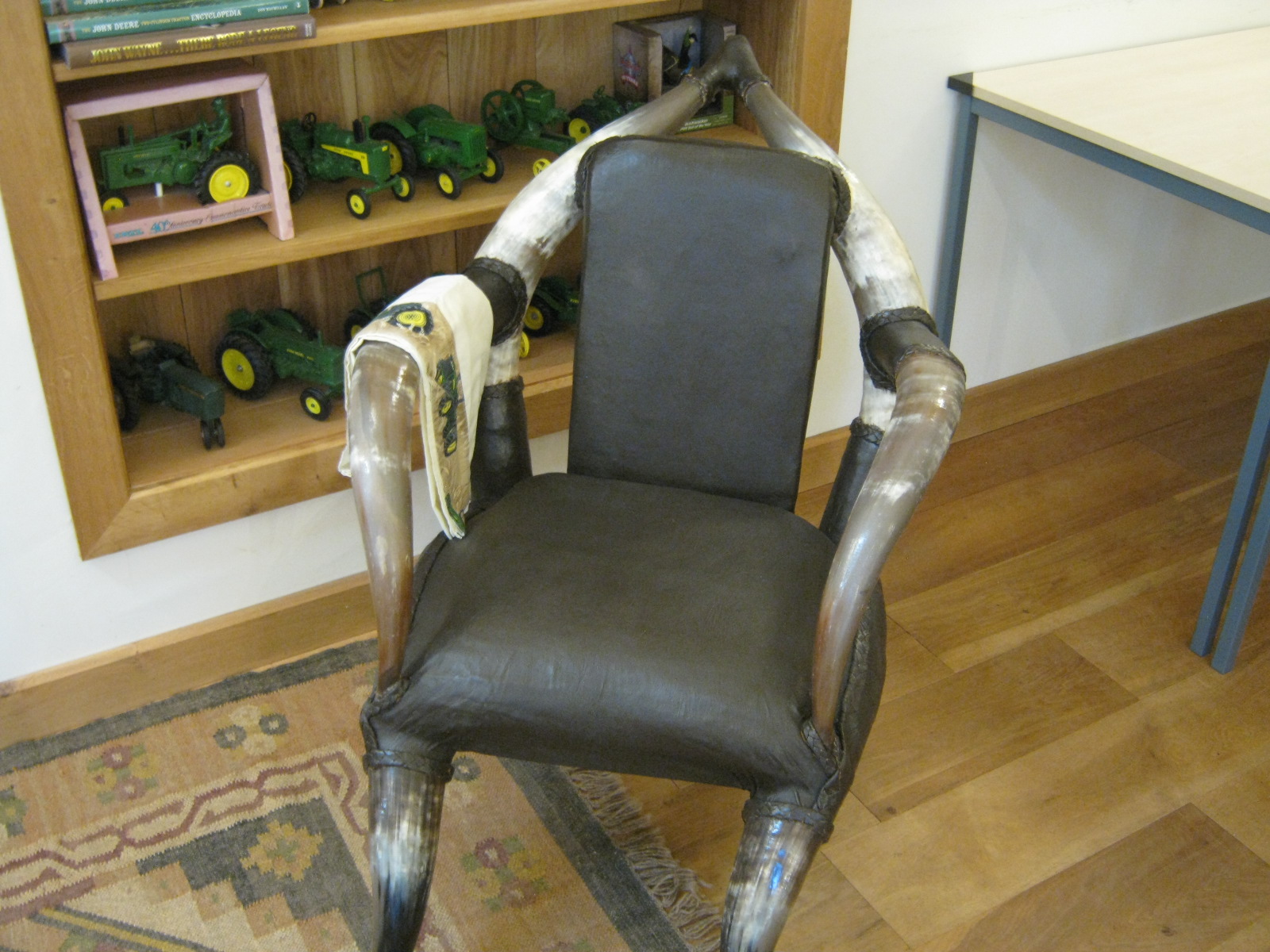
Surely the largest hornware artefacts you will see are the horn chairs? They are not only dependent on a ready supply of long horns, but on a ready supply of pairs of long horns.  Most of these items, unsurprisingly, come from Texas and the Western States.

Quite by accident I found a small collection of these unusual horn craft artefacts, seldom to be found outside the US, whilst visiting Parc Grace Dieu farm near Monmouth. My intention was to photograph their White Park cattle and I took along my postcard collection for reference. Anna, who met me, was very interested by these pictures and immediately latched onto one depicting a chair made from cow’s horns, taken in the Morse Museum, Warren, New Hampshire.

Image ref: Postcard of a horn chair from the Morse Museum
Image credit: Rebecca Davies


As it turned out, they have a few of these chairs at Parc Grace Dieu, and Anna was delighted to show me them. Their main chair came from Stockyard City, Oklahoma.

Image ref: Horn chair
Image credit: Rebecca Davies


This smaller chair was made by Abbey Horn

Image ref: Abbey Horn chair
Image credit: Rebecca Davies


Notice the back of this chair; it is designed so that pairs are not needed.

Image ref: Abbey Horn chair back
Image credit: Rebecca Davies

And they have a pair of chairs from Africa, possibly East Africa, where the Ankole cattle come from.

Image ref: African horn chair
Image credit: Rebecca Davies


All in all, a very interesting collection. I think I am going to save up and find myself a Horn chair of my very own. These artefacts are not actually that rare, you can find examples through online auction sites, but they are not cheap either.

Rebecca Davies


Abbey Horn - https://www.abbeyhorn.co.uk/

Alan Rogers Texas Longhorn Museum - http://www.longhornmuseum.com/index.htm

Parc Grace Dieu Farm - https://www.parcgracedieufarm.co.uk/

Friday, 21 August 2020

Record store day

In a normal year, one day in April would see over 200 independent record shops across the country coming together on Record Store Day.  However, as with many things in 2020, celebrations have had to be postponed.  So, instead of one day to celebrate vinyl records and the stores that promote them, we get 3 new dates instead: 29th August, 26th September and 24th October.

https://recordstoreday.co.uk/about-rsd/about/

Vinyl LPs were introduced in 1948 and were outsold by CDs for the first time in 1988.  In the past couple of decades vinyl sales have risen with a renewed interest in the medium being sparked in 2006 with the release of albums such as Arctic Monkey’s debut, ‘Whatever People Say I Am That’s What I’m Not’.

A 25-year high was reached in 2016 vinyl with more than 3.2m LPs sold, this was a year that saw the death of many musical heroes including David Bowie, Prince, Leonard Cohen and George Michael. The loss of these highly regarded artists is considered a large factor in 2016’s surge in vinyl sales, with fans buying mementos of their musical icons. After David Bowie’s death he became the bestselling vinyl artist of 2016.

http://www.phonostage.co.uk/history-vinyl-records/

Philips Stereo 200, AIBDC 008068

William Hernandez Abreu
Gallery Technician, TheGallery.