Last
week MoDiP opened its latest exhibition, Designated Design: A collection of
national importance. It celebrates the wonderful accolade we received earlier
this year when Arts Council England awarded the museum Designated Outstanding Collection
status. The exhibition is based upon themes taken from the original application
we put forward, such as considering the scope and scale of the collection and
its research potential. We have spent several months working with colleagues
from within the AUB’s External Engagement team planning layouts, acquiring
display furniture and designing the space etc. so this has truly been a
collaborative effort.
Image credit: elizanaden_photography
The image above shows the
exhibition curators, Professor Susan Lambert (left) and Dr Louise Dennis (right),
standing in front of a mind map illustrated by commissioned
artist Bridie Cheeseman. It is a great way of visually representing the work of
the museum and takes up the central wall in the lower gallery.
Also to be found in this area are examples of the MoDiP
Student Creative project, run each year as a bursary awarded opportunity for
AUB students to produce an output inspired by the museum and/or its objects, as
well as three examples of projects undertaken by external artists, who have each
interpreted the collection in a different way.
Image credit: elizanaden_photography
The
main area of the upper gallery features some of MoDiP’s large objects as well
as a variety of plastics design classics (refer image below). We were able to
re-configure some frames acquired for a previous exhibition within which we
have placed objects on open display. It was quite tricky stabilising the Pinarello
road bike (refer image below), despite the fact that it has a carbon fibre
frame so is incredibly lightweight. We were very grateful to receive assistance
from two of our colleagues in AUB Modelmaking – big thanks to Paul Johnson for helping me to hold the bike whilst
Louise secured it, and to Gideon Bohannon for pumping up the tyres!
Image credit: elizanaden_photography
We
have included some handling collection objects to demonstrate the plastics
materials most frequently encountered within museum collections. Visitors are
encouraged to pick these up to feel the differences, with some great examples
of fake fur, inflatable PVC and bakelite. Once the exhibition closes, we will
develop this learning resource into another MoDiP grab box, which will be available
for loan to groups interested in finding out more about this amazing material
family.
Image credit: elizanaden_photography
The
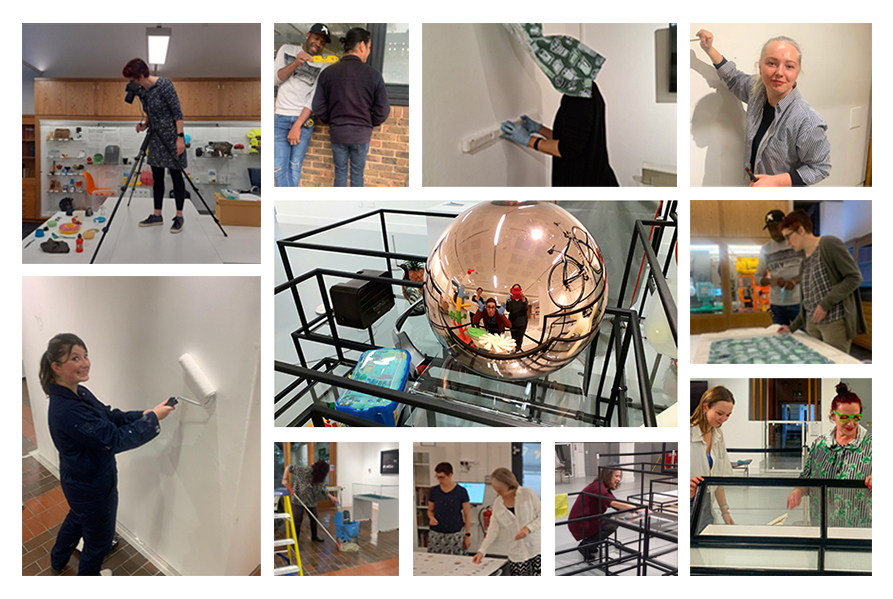
past few weeks, as deadlines were looming, have seen a flurry of activity (refer image below) with the team
also having to endure Covid and heavy colds at the same time! But we
got there in the end!
Image credit: MoDiP and TheGallery
Designated Design: A collection of national importance, will be on display in TheGallery until 22nd December 2022.
Six years ago, MoDiP hosted an international conference called Provocative Plastics, which took place over two days at the Arts University Bournemouth to explore the past, present and future potential of plastics. At the same time, we had an exhibition of photographs on display in TheGallery by Mariele Neudecker, to compliment the conference: Plastic Vanitas.
Plastic Vanitas
on display at TheGallery
Image credit: TheGallery
The basic premise of the project was to re-present the MoDiP
collection as a series of Vanitas paintings. Vanitas was a specific form of
Dutch still-life painting that became increasingly popular in the 17th
century. Compositions included objects that carried symbolic meaning, such as a
clock representing the passing of time, jewellery indicating wealth and food/wine
alluding to pleasure. All of these would build up an overall moral message: the
vanities of life are fleeting and, since death is inevitable, we should live
our lives in the moment, as fully as possible.
One
bay of shelving in the MoDiP store.
Image credit: MoDiP
Mariele
had the opportunity to go behind the scenes at MoDiP and discover the
collections for herself, removing boxes from the shelves at random and
unwrapping the objects within them to see what they were. She became interested
by how the objects were actually stored: by material, size and weight (heavy
boxes on the bottom of the shelving and lighter ones at the top), in
accumulations of objects that often make no intellectual sense.
To
explore this further, she decided to ask the MoDiP team to identify potential
objects that could represent the symbolism she was looking for. She would then
take the entire box that each object was stored in and use all of the other
items within (previously unseen by her) to form part of the still-life. The
work was created in the Arts University Bournemouth's photographic studios with
assistance from a team of students studying BA (Hons) Photography and BA (Hons) Commercial Photography.
In
the artist's words:
I wouldn't call myself
a photographer. I use photography but it's usually outdoors and photographing
what's there, rather than setting up scenes like this. I'm learning loads about
lighting etc. It's really fun how each student has their own tricks up their
sleeve, which they're happy to share.
Mariele Neudecker
One
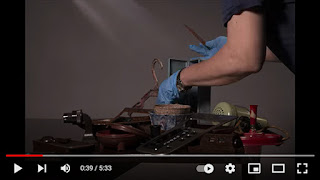
student, Julio del Castello Vivero, recorded his experience as a time lapse animated film showing the process of the objects being
unwrapped, positioned, lit and then photographed (refer below).
In total, Neudecker produced 49 photographic artworks that
she has subsequently toured around the world. We have a selection on permanent
display outside the museum, on the first floor of the AUB Library. Here are two of my favourites:
Still
Life with Lemon and Apples - (the contents of Box 653).
Image credit: Mariele Neudecker
Still Life with Thermos jug and Door Handle - (the contents of Box 316). Image credit: Mariele Neudecker
In remembrance of Leo
Gauvain, seen in the image below on the left, smiling (he was always smiling)
with Julio del Castello
Vivero, myself and Pam Langdown.
Setting out
objects in the AUB photography studio. Image credit: Louise Dennis
Working in a museum situated in an arts university opens up special avenues. We are particularly keen to involve artists in interpreting the museum’s subject and have been pleased to host residencies of the fine artist, Mariele Neudecker, and the musician, Karen Wimhurst, both supported by Arts Council England.
Mariele developed a series of art photographs presenting the collection as ‘vanitas’ paintings
Plastic Vanitas -Still Life with Flower and Poodle [AIBDC, 237, CR, 90, Shelf 2 of 8, 3.8kg] . Art photography by Mariele Neudecker
Karen developed a chamber opera, with soprano, plastic trumpet and live vinyl DJ. It explores our plastics age through a series of sung chapters timelining the meteoric rise of plastics throughout the twentieth century to ‘Synthetica’, the world we live in today. On one level this is an ‘every person’ mythic tale initially heralding a glorious new age free of poverty and exploitation of nature which leads us to a different reality unfolding in the twenty-first century. It tells of the desire to move beyond nature for the betterment of humanity and ends with returning to closed loop systems of the natural world. On another level, it is a cross genre reflection on a complex web of design, scientific discovery, history, and the power of marketing.
‘Synthetica’ was workshopped at the Lighthouse, Poole, in 2018 and premiered, as part of the Tête à Tête Opera Festival in London last summer, directed on both occasions by the AUB’s Acting Course Leader, Katharine Piercey Bill Bankes Jones, Tête à Tête's Artistic Director, said: 'We were extremely pleased to host Synthetica... It was a great addition to our programme… innovative, thought provoking, a great score and a virtuosic cast. Moreover, it’s billing in the Plastics and Rubber UK Journal proves it can reach places other operas can’t go!' It was Frances Lynch of Electric Voice Theatre's favourite opera in the festival: '...cutting edge, provocative, with a truly exciting score and great live performances... It stood out as an opera for our times and deserves a wide audience.' You can enjoy excerpts from it here
We were so pleased and excited early this year when Arts Council England offered further support to build on the success of that performance. The intention was to tour the show to a minimum of six venues, even to take it abroad. However, for the time being at least, lockdown has put our plans into abeyance. Theatres are closed and staff unavailable. Planned performances have had to be cancelled and making contact with theatres is proving challenging. Although there is some easing of lockdown, it is not known when live performances will be allowed.
Therefore, in navigating the unknown territory that Covid 19 has thrown up, we hope in the shorter term to be able to create an online version. As the opera is already split into chapters, each one of these can be presented for people to access from an initial menu. The circularity of a vinyl LP and the lock groove turning round and round is a central image to be used. The proposal is to film the opera simply with the head of the singer ‘Zoom style’ on a green screen backgrounded by a playful collage of objects from the MoDiP collection including ads from 1940’s magazines, excerpts from the libretto, and textures of plastics materials, which the singer can manipulate. As well as the opera scene itself, each chapter will contain educational resources for release to schools nationally.
Whatever the state of lockdown, MoDiP remains interested in working with artists. Although ideally a residency involves hands-on contact with museum objects, we are fortunate at MoDiP that most of the collection has been photographed. Indeed we believe we have the best quality and largest collection of images of objects made of plastics in the world. In these strange times we would be especially interested in creative interaction with the online collections. Indeed, with or without lockdown, there is much that could be done with the digital collection. Do get in touch if you have ideas, digital or otherwise, that you would like to talk through: modip@aub.ac.uk.
At the end of May the Plastics Heritage Congress, a three-day international conference, was held at the Museu Nacionale dos Coches, Lisbon, Portugal. The theme of the conference was History, Limits and Possibilities and attracted delegates from all over the world, including the USA, Australia, Africa, and all over Europe.
The keynote lecture by Jeffrey Meiklewas particularly interesting to me as his bookAmerican Plastic: A Cultural History plays a vital role in my PhD research.
All of the three days were split into two streams and it was difficult to choose between which talks to attend because they all sounded fascinating.
On the Wednesday, I chaired a session entitled Museums, Collections and Archives and introduced papers presented by Cancy Chu, University of Melbourne, on the Impact of plastics on archives; Vitězslav Knotek, University of Chemistry and Technology in Prague, on the Identification and degradation of cinematographic films with magnetic audio track; and Masahiko Tsukada, Tokyo University of the Arts, on the Material analysis of animation cels produced in early 1990s before the digital era. All of which looked at the analysis of the materials used and considered how they might be stored.
On the Thursday, the papers were focused on conservation and cleaning techniques and concluded with a coach trip to a museum in Leiria in central Portugal to view an exhibition about plastics. I will write another blog post all about the exhibition and the objects included.
On the last day, I presented a paper entitled Making Connections: the development of relationships between museum visitors and objects of historic polymeric materials which was received favourably. In addition, alongside Katherine Curran, Suzan de Groot, Ruth Keller, Maria Joao Melo, and Geoffrey Mitchell, academics from across Europe, I judged the poster entries and awarded the prizes.
One of the speakers on the Friday was Mariele Neudecker, talking about her MoDiP project Plastic Vanitas.
It was nice to see the image below on one of Mariele’s slides showing my colleagues, Pam Langdown and Katherine Pell, alongside two students who worked with Mariele on her project. The student on the left side of the image, Leo Gauvain, sadly lost his life when he returned to Bangkok after completing his degree in photography at the AUB. The team at MoDiP were very sorry to hear about this tragedy.
Through-out the three days, I learnt a lot about all kinds of plastics materials, from Gutta Percha, a material derived from tree sap, to Carbolite, a Russian version of the more commonly known Bakelite, and met some great people working on some amazing projects.
All you
have to do is collect together plastic things, arrange them, and take a
photograph. The resulting image should be memorable and express your
ideas about the material.
You
could choose to photograph any objects as long as they are made of
plastic. They could be things you find in your home, for example in the
kitchen, bathroom, or potting shed; things that you think are especially
beautiful/ugly or useful/useless; or things that you come across during
a walk in the park or along the beach.
Inspired by the work of Mariele Neudecker, children are invited to explore and respond to the exhibition by making their own creations. Part of The Big Draw Festival.
Free Family Day: 11.00am - 3.00pm. Drop in session, no booking necessary. Suitable for ages 3 and above. Children must be accompanied by a supervising adult.
Did you know that you can find out more about the Plastic Vanitas exhibition on display in TheGallery by coming along to a Panel Discussion?
Date of Event: 15th October 2015
Last Booking Date for this Event: 15th October 2015
The Panel will discuss the themes explored in the Plastic Vanitas exhibition, followed by a Drinks Reception and Private View. Formal Welcome Address by Professor Emma Hunt.

.JPG)
.JPG)