Showing posts with label engagement. Show all posts

Wednesday, 5 April 2023

Curatorial talks

As a museum curator of a small museum, I find that my work each week can be varied and extremely interesting.  This last week has been full of working out budgets for the coming year, thinking about new acquisitions, updating object records, and thinking about our next exhibition.  I have also been doing lots of talking. 

Firstly, I was invited to the Museum of Richmond to talk to volunteers, staff and trustees from the museum and a group of arts students from Richmond College.  The Museum of Richmond are working towards putting together an exhibition entitled ‘Artificial Silk: From Kew to the World’ which will open to the public in late June. I was joined by Calvin Wooding, a fibre specialist, who spoke about the production of the material, whilst I put the invention in the wider context of plastics development and culture.  It was a great day with a wide-ranging audience, the students will be responding to the subject by creating art works that will feature in the exhibition.  I am really looking forward to going back and seeing the end results.


https://twitter.com/museumrichmond/status/1642131764691738624


My second public presentation was part of the AUB Open Lecture series.  These lectures are hosted at AUB by the Innovation team and are aimed at external and internal audiences.  My lecture was entitled Making connections: objects, visitors, curators.  Here I drew on topics and themes that were part of my PhD thesis and explored the ideas of:

  • What makes a museum?
  • Value and meaning
  • Relational materiality and the relational museum
  • The role of the curator

Making connections. Image credit Lucy Devall

Throughout the presentation I used personal experiences to illustrate academic thinking around collecting and the function of museums, with particular attention given to the difference between the act of private collecting and that of the public museum.  I talked about how we assign value to objects, and how this effects the way we relate to them, as well as the kinds of energies that are generated by object encounters.

If you would like to find out more about future AUB Open lectures sign up to the AUB Engage mailing list where you can be kept up to date with all the cultural activity from the museum and our engagement colleagues.

Louise Dennis

Curator of MoDiP


Wednesday, 7 December 2022

Designated Design seminar

In this week’s blog post we would like to look back on an afternoon seminar we held at AUB on 1st December in partnership with TheGallery.  The seminar sat alongside our Designated Design: a plastics collection of national importance exhibition both of which are a celebration of, and thank you to, Professor Susan Lambert who has headed up the museum since it took the step to focus on design in plastics.   MoDiP was established in 2007 having emerged from an existing collection of designed objects at the AUB, Susan saw a specialist and underrepresented vein running through that collection and nurtured it to become internationally recognised with impact on the academic, museum, and public spheres.

Designated Design: a plastics collection of national importance exhibition. Image credit Eliza Naden.

The event was kicked off with a hearty welcome from AUB’s Vice Chancellor, Professor Paul Gough.  This was followed by a session exploring the work of three artists who have worked in different media and in different ways with MoDiP’s collection.  The first speaker was Mariele Neudecker, an artist who took part in a residency at MoDiP in 2015 entitled Plastic Vanitas.  Plastic Vanitas was a series of 49 photographs each one representing the entire contents of a box of stored objects from the MoDiP collection. These boxes were chosen because they contained at least one object that represented the symbolism found in 16th and 17th century Vanitas paintings. Mariele’s self-imposed rule was that whatever else was in the box was to form part of the still life. 

The next presentation was from Karen Wimhurst, MoDiP’s first Musician-in-Residence, who described w-RAP one, a performance she created alongside pupils from Ferndown Upper school in 2018, w-RAP two, a piece written by Karen featuring soprano Brittany Soriano (soprano), Elaine Close (trumpet) and Ole Rudd (vinyl), again in 2018, and w-RAP three, a collage of soundscapes from w-RAP one and two.  These projects subsequently feed into the chamber opera Synthetica: a toxic enchantment in 2019.   

Finally, we heard from Frances Scott, who had visited MoDiP in 2019 as part of her role as Resident Artist for the Raw Materials: Plastics exhibition, exploring the forgotten history of plastics in east London and held at the Nunnery Gallery. Frances spent time with the collection, scanning objects for her filmPHX [X is for Xylonite]’ through which she wanted to explore the relationship between the first semi-synthetic plastics and the chemical and industrial development of photography and film. We were treated to an excerpt of the film (the entire piece is currently on display in TheGallery), with a soundtrack featuring readings from Roland Barthes’ classic essay ‘Plastics’ (1957).

All of the artists were then invited to join together for a panel discussion chaired by Professor Paul Gough.  All three artists spoke warmly about their time connecting with the museum and the collection, and it was a pleasure to work with each of them.

Mariele Neudecker in front of some of the Plastic Vanitas photographs (image credit: Eliza Naden), Karen Wimhurst performing a new piece (image credit Eliza Naden), a still from Frances Scott’s PHX [X is for Xylonite] (image credit Frances Scott).

The second session was hosted by Dr Anna Farthing, AUB’s Director of Civic and Cultural Engagement, and explored the value of the status of ‘Designated Outstanding Collection’.  Speakers came from a range of museums, some of which had collections recognised by Arts Council England in the earliest days of the scheme in late 1990s, and others had been awarded the status more recently.

The museum speakers were Kate Arnold-Forster - Director, University Museums and Special Collections Services, University of Reading and Director, Museum of English Rural Life, Andrea Bishop - Director of Collections & Engagement, National Motor Museum, Carolyn Abel - Director of Culture, Southampton City Council, and Jo Elsworth - Associate Director (Culture and Collections), Library Services + Director: Theatre Collection, Faculty of Arts, University of Bristol.

Panel discussion led by Dr Anna Farthing with Andrea Bishop, Carolyn Abel, and Jo Elsworth.  Kate Arnold-Forster presenting. Image credits Eliza Naden.

The collections and experiences shared were fascinating.  Many of the same themes came up from all four speakers.  They spoke about how the status of designation made the staff think about the meaning and importance of the collections in their care, and how it gave the staff pride and a heightened sense of responsibility.   The status meant that designers and artists wanted to be associated with the collections, and other stakeholders, including senior managers, began to understand their importance.   The most significant statement that came out of the session was that the assessment was made independently.  We can all say that our collections are special but as the accolade has been awarded by an independent, external body it means that the status is confirmation of the significance of our collections.

We would like to thank everyone involved in the event including Paul and Anna for chairing the two sessions, our colleagues in TheGallery, the Civic and Cultural Engagement team, and BA (Hons) Events Management colleagues who supported the online streaming of the event.  We would especially like to thank all the speakers who made the seminar so interesting, and the delegates who joined us.

Louise Dennis, Curator, and Katherine Pell, Collections Officer

Wednesday, 8 June 2022

Plastic: Remaking our world

As you may have seen on our Instagram feed, MoDiP has had the great pleasure of loaning objects to an international exhibition curated by Vitra Design Museum, V&A Dundee, and maat.  The exhibition Plastic: Remaking Our World, which will be hosted by all three museums (Vitra Design Museum in 26.03.2022 – 04.09.2022, V&A Dundee 29.10.2022 – 05.02.2023 and maat, Lisbon spring 2023), examines the history and future of this controversial material: from its meteoric rise in the twentieth century to its environmental impact and to cutting-edge solutions for a more sustainable use of plastic.  Exhibits include rarities from the dawn of the plastic age and objects of the pop era as well as numerous contemporary designs and projects ranging from efforts to clean up rivers and oceans to smart concepts for waste reduction and recycling through to bioplastics made from algae and mycelium.

The case at the front of this picture displays objects from the Worshipful Company of Horners, whose collection we look after. © Vitra Design Museum, Photo: Bettina Matthiessen

Dr. Jochen Eisenbrand, Chief Curator, Vitra Design Museum stated that the Museum of Design in Plastics has been most supportive of our exhibition and we are most grateful for this support. During our research and preparations for the show – all of which coincided with two years of COVID pandemic – MoDiP’s excellent online collection and the wealth of information it provides proved to be a most valuable asset and resource that the curatorial team of the exhibition kept coming back to again and again.’

Vitrac picnic ware and Sputnik jam dish from the MoDiP collection. © Vitra Design Museum, Photo: Bettina Matthiessen

He goes on to say: ‘Among the many wonderful and important loans that MoDiP is generously supporting our exhibition with are a Hawker Sear Fury cockpit canopy as the largest historic exhibit we are presenting and also some of my personal favourite exhibits: the Hax and Flip squeeze bottles from the 1950s and 1960s in the shape of a lemon, a banana, or a strawberry.’

Military lamp, Plasfort helmet, and fighter plane cockpit canopy from the MoDiP collection. © Vitra Design Museum, Photo: Bettina Matthiessen


Sqezy bottle BXL image, hax bottles and Sqezy washing up liquid bottle from the MoDiP collection. © Vitra Design Museum, Photo: Bettina Matthiessen


As a whole, the exhibition offers a critical and differentiated reassessment of plastic in today’s world. Interviews with designers, scientists, and activists underline the importance of an interdisciplinary approach in which politics, industry, science, and design collaborate closely to tackle the plastic problem.  While it is true that each of us is a catalyst for change, there will be no simple remedy to this issue. For this reason, the exhibition aims to address the bigger picture of plastic and its complex role in our world: by analysing how we came to be so dependent on it, by reassessing where the use of plastic is essential and where it can be reduced or replaced, and by reimagining possible futures for this contested material.

I am looking forward to visiting the exhibition when it comes to the UK and I am sure I will share more about it in another blog post in the winter.  In the meantime, find out more on the VitraDesign Museum website.


Louise Dennis

Curator of MoDiP


Wednesday, 20 April 2022

Earth Day 2022

With Earth Day coming up on April 22, MoDiP has a session today with students from our Creative Writing course in support of Dr Kevan Manwaring’s ‘Writing the Earth’ Programme. 

Many discussions across the world this week will explore the negative impacts that plastics and the products they are made into can have on the environment.  These discussions are extremely valid especially when we see the horrific amounts of detritus that clog our water ways and can be seen in overflowing waste heaps across the globe.  I am certainly not going to counter the opinions that such waste should not be in our seas, streets, or countryside, but I will be exploring with the students some of the interesting ways designers and manufacturers use plastics in a more thoughtful, and sustainable way.  As with much of the activity of the museum I will be acknowledging the negative impact the poor use and disposal of plastics materials has on the environment, and show how valuable plastics, as a materials group, can be when used appropriately.

Plastics are a group of materials that have no inherent shape, colour, or texture.  The amazing thing about them is that they can become anything we want them to be.  They are celebrated for having a long life.  At the same time, they are vilified for having a long life when they are in the wrong place.  Nobody wants to see waste (of any kind) in our seas, on our beaches, in our streets.  Plastics are particularly highlighted as a waste issue because they are so visible.  They are light in weight and often colourful, and so can be easily seen floating in water, blowing in the wind, and caught in trees as litter.

The overuse of plastics has its origins in the early twentieth century, where disposability, and the notion of using something once and then throwing it away grew to become a sign of wealth and cleanliness.  In the West, consumers were encouraged to use disposable products for their efficiency and to avoid contamination.  The ideas of purification and convenience encouraged the development of ethical justifications for the use of disposable items.  It will take time to change human behaviours - whether as designers, manufacturers, or consumers.

Value

Much of the issue with plastics is that they are seen as ‘cheap’ materials that are made into ‘cheap’, throw away products.  This is exacerbated by the use of plastics to create single-use products, particularly packaging, which has little or no perceived value.  This is because it is not our intention to purchase the packaging; only the product inside it.  Consumers do not readily see that investment has been made into the research and development of the packaging, that it has a material cost, and it has value in its function - to contain and / or protect the contents.  If we were more readily able to recognise the value of such products, we would be more inclined to maintain that value within a circular system.

One way of showing value is by creating objects that are well designed and highly desirable.  This is demonstrated in our current exhibition, Why plastics?, in our Affordable case.  The relative cheapness of mass-produced plastics objects means that well-designed and well-made, fashionable or timeless products can be acquired by a wider demographic of consumers. From the 1940s, European companies placed significant investment into the production of quality objects, made of materials that were fit for purpose. The ‘good design’ concept developed by the Council of Industrial Design (CoID) was adopted by the British plastics industry to bring simple but functional products to the British public. During this time some plastics firms set up their own design studios to create objects that were well conceived and used the materials at their disposal to the best of their abilities. Well regarded designers included A.H. ‘Woody’ Woodfull for British Industrial Plastics, David Harman Powell for Ranton & Co, and Martyn Rowlands for IMI Opella. As time went on other companies, such as Habitat and Ikea, have used designers and design studios to bring ‘good design’ in plastics to the masses.

Designs by Woody Woodfull (AIBDC : 008014), David Harman Powell (AIBDC : 007869.2), Martyn Rowlands (AIBDC : 003367.1), and for Habitat (AIBDC : 008800), and Ikea (AIBDC : 006166.1).  Image credit: MoDiP.


With Bournemouth beach being popular with families, we see lots of beach toys being left behind; because they can be purchased so cheaply, they are seen as lacking in value.  A local initiative set up by an AUB MA student enables people to borrow toys rather than buying a cheap bucket and discarding it.  https://aub.ac.uk/latest/check-it-out-ma-student-designs-boscombes-new-toy-library

Image Credit MoDiP - https://www.instagram.com/p/CVKbds7owoS/?utm_source=ig_web_copy_link


An alternative to borrowing is to ‘buy once and buy well’.  If you acquire objects that you would not want to leave behind, you are more likely to make sure it goes home with you.  And when your children have outgrown the toy, it will still be in good condition and be desirable enough to be handed on to other families.  The Ekobo sand toys are a case in point.  They are beautifully made using recycled sawdust from a chopstick factory in a bio-based resin meaning they are desirable, durable but also biodegradable.

Sand toys by Ekobo (AIBDC : 008195.2, AIBDC : 008195.3, AIBDC : 008195.1, AIBDC : 008196). Image credit: MoDiP.


Recyclability

If the facilities, such as good bin provision, are available and the consumer or manufacturer is willing, all plastics have the capability to be recycled. Some materials are more easily reprocessed than others, and it becomes more complicated when multiple materials are used in combination, either through lamination or separate componentry.

The simplest materials to recycle are the thermoplastics, those which can be shredded, melted, and reprocessed. Other plastics materials, the thermosets, have to be ground or chipped to be reused. The latter is a more laborious process and as such is seldom done.

There are many factors which make it difficult to recycle plastics materials. If a material is dark in colour, the resulting recyclate also has to be dark. To counter this, Coca-Cola changed its iconic green Sprite bottle to clear in 2019, and Dai Nippon Printing use an external, removable film to provide colour to their clear bottles.

Sprite bottles (AIBDC : 008416.1AIBDC : 008416.2), Awanama Sake bottles (AIBDC : 008379.1AIBDC : 008379.2).  Image credit: MoDiP.

Reusability

Recycling uses energy and other resources, as such the most sustainable way to maintain the most material value in a product is to reuse it.  As mentioned previously plastics materials are durable and this means that they make great products for reuse.  The robustness of some plastics materials makes reusable drinks bottles and lunch boxes safe and reliable and means that we can avoid single-use alternatives.

eau good bottle (AIBDC : 007138), Kokeshi Hanako bento box (AIBDC : 007761), Stackable lunch box (AIBDC : 007763), Gumtech coffee cup (AIBDC : 007951). Image credit: MoDiP.

Alternative feedstocks and materials

Most plastics as we know them are made from fossil-fuels which are finite resources.  Although the production of plastics only uses 4% of the world’s oil production, with the rest being used for energy, transport, and heat, manufacturers have for some time been experimenting with alternative, plant-based, feedstocks. Plant materials including cornstarch, needles from pine trees, algae, and wood are harvestable, with some growing very quickly, therefore they provide a more sustainable raw material with an almost limitless supply.

Innocent bottle (AIBDC : 005703), Kupilka 55 bowl (AIBDC : 007498), Ultra Bloom shoes (AIBDC : 008116), Toy Seaplane (AIBDC : 008176). Image credit: MoDiP.

Plant-based materials, also known as bioplastics, need careful consideration within the wider production context of water, chemical and land use all of which have an environmental impact. The end of their life requires careful consideration too. Products made of bioplastics are not always biodegradable.  If they are compostable, they often need industrial conditions. If they degrade within a recycling system they can undermine and weaken the resulting recyclate, and in landfill they can produce methane, a greenhouse gas, as they breakdown.

Other alternative materials for the creation of new products can come from materials that are already in existence.  The Airpaq bag, for example, makes use of reclaimed materials such as car airbags and seat belts.  The skateboard and rash guard use recycled fishing nets, either before they are discarded into the sea or those that have been reclaimed from the oceans where they are described as ghost nets which continue catching fish and other marine life.  The gumdrop uses recycled chewing gum and attempts to prevent a source of waste from looking unsightly on our streets.

Airpaq bag (AIBDC : 008171), Minnow skateboard (AIBDC : 007963), Solange rash guard (AIBDC : 008185), Gumdrop bin (AIBDC : 007949). Image credit: MoDiP.


Waste reduction

Many of the sustainable aspects of plastics products are derived from their durability and recyclability. However, one property that enables them to have a positive environmental impact, but one that is often overlooked, is that they are lightweight. In terms of packaging, by being light in weight, plastics products take up less space and require less fuel than heavier materials like glass, for example, in transportation. Plastics packaging also helps to reduce losses and damaged contents, therefore preventing food waste. The relative lightness in weight, when used in car parts, saves on average over the lifetime of the standard car, 3000 litres of fuel.   

Celebrations tub (AIBDC : 005907), Original Source pouch (AIBDC : 005924), Smart car wheel arch (AIBDC : 006115).  Image credit: MoDiP.

The Bodyflik is a squeegee which scrapes off excess water from your body after washing.  It was designed to reduce the amount of water absorbed by a bath towel meaning the towel would dry more quickly and need changing less often.  This helps to reduce household gas and electricity bills.  The Jar Tops divert glass jars from landfill or the recycling process by giving them a second life.

Bodyflik (AIBDC : 005910), Jar Tops (AIBDC : 005916).  Image credit: MoDiP.


Doing good

Plastics can be used to play important environmentally supportive roles.  Fence booms are used as an emergency response, or for long term deployment, to contain oil spills or debris, in calm or sheltered waters such as harbours, rivers and ponds.  By containing a spill, the boom prevents more of the environment from being affected by the contaminant.

The sustainability of the modern commercial fishing industry is affected by the discarding of excess catch due to fishing quotas and bycatch. The Pisces and the ProGlow use LED light to influence fish behaviour.  Both examples are housed within a robust polycarbonate case that can withstand the pressures of deep water. Pisces illuminates the fishing net and emits six different colours to either attract or repel specific species. The ProGlow is a cheap and reusable alternative to single-use glow sticks that are environmentally damaging when thrown overboard at end-of-life; it is estimated that 700 million end up in the oceans every year.

One day in 2020 saw 22 tonnes of rubbish removed, by the council, from Bournemouth and Poole beaches after half a million people visited the area. Beach goers left behind food packaging, disposable barbeques, buckets, spades, toys, clothing, beach shelters, and other equipment. Ideally all visitors to the seaside would take responsibility for the rubbish they generate. Alternatively, to stop this litter getting into the environment, many charities and groups, including the 2 Minute Beach Clean, Keep Britain Tidy, Surfers Against Sewage, Dorset Devils, and many more, organise beach cleans, where individuals are encouraged to come together and remove the debris.  Many plastics products are used to gather and take away the rubbish including refuse bags.  A reusable alternative is the 4Ocean Beach Bag and Cleanup Tote with its mesh material which allows sand and water to drain out keeping it lightweight and easy to carry.

Fence boom section (AIBDC : 008199), Pisces light (AIBDC : 008603), ProGlow (AIBDC : 008601), 4Ocean Beach bag and cleanup tote (AIBDC : 008678). Image credit: MoDiP.

Louise Dennis

Curator of MoDiP

Wednesday, 20 October 2021

Object Analysis sessions

As term begins and the Arts University Bournemouth continues to welcome back students, we are beginning to return to some kind of normality. Over the past couple of weeks, we have been having zoom conversations with courses, introducing and reintroducing them to the museum and how they can use the collection, and welcoming small groups of students into our space to explore objects in greater depth. It is so nice to have this activity back on campus.

One session we have been doing over the past few days is that of ‘Object Analysis’ with two costume courses: BA Costume, and BA Performance Design and Film Costume.

In these sessions, students develop skills that enable them to gain information about the objects in front of us. We started the session with an introduction to MoDiP. We then looked at the objects on the table, without picking them up, to see what we could glean from them. Next, we had a quick session on how to handle museum objects, followed by time to explore the objects in more depth to see if that provides additional information. We used an object analysis form which can be found on our website with a series of questions. Those question include:


Function
  • What was the object’s likely purpose?
  • How was it used?
  • Consider size, weight, portability, ergonomics etc
Date
  • When might the object have been made or used?
  • Why do you say this?
Manufacture
  • What is it made of?
  • How was it made?
Audience
  • Who was it made for?
  • Who would have used it?
  • Are they the same?
Appeal
  • What was the appeal of the object?
  • Consider its desirability / aesthetic appeal / use.
Acclaim
  • Has the object won any awards?
  • Can it be attributed to a particular designer or manufacturer?
Significance
  • Does this object demonstrate any significant developments in design or technology?
  • Does it represent changes in social or political attitudes?

The selection of objects.  Image credit: L Dennis 

Each group were asked to select three objects out of the eight that were on the table. I specifically selected objects that might be new to the students but would have tell-tale clues that could lead to further information.


The Cameras

https://www.modip.ac.uk/artefact/aibdc-066571. Image credit: L Dennis

I chose the cameras because I thought that film cameras would not be something that all of the students had encountered. We spoke about what they looked like and what they reminded us of. Suggestions included disposable cameras and waterproof GoPros. They are quite unassuming, simple objects but with a bit more research we found that they were designed by Sebastian Conran for SupaSnaps.


The Shoes

https://www.modip.ac.uk/artefact/aibdc-008116. Image credit: L Dennis

The shoes proved to be an easy identification for most of the groups. They could obviously see that they were shoes without picking them up, they also figured out that they were for use in water and they might have something to do with sports. Despite reading out the label on the box - ‘Algae Green’ - no one clocked that the shoes were particularly interesting because they were made using algae as a feedstock for the plastic material.


The Pink Thing

https://www.modip.ac.uk/artefact/aibdc-007949. Image credit: L Dennis

The pink thing was selected by nearly all of the groups. Without picking it up, for the most part they couldn’t identify its function – the first question on the object analysis form. Without knowing its function, the groups struggled with any of the questions that followed. Once they were able to handle the object they discovered so much more about the ‘pink thing’ because it has a label on the side that contains so much information. It is a bin designed to collect waste chewing gum (rubber) which is then recycled, with the contents, to create more bins and other products.


The cream coloured block

https://www.modip.ac.uk/artefact/phsl-x12-0. Image credit: L Dennis

This block was chosen a couple of times by the students but because it didn’t look very interesting compared to the other things on the table it was overlooked by most. The groups that did choose it discovered there was more to it that meets the eye. They thought it might be old but hadn’t anticipated that it would date from the 1870s and made by Daniel Spill.


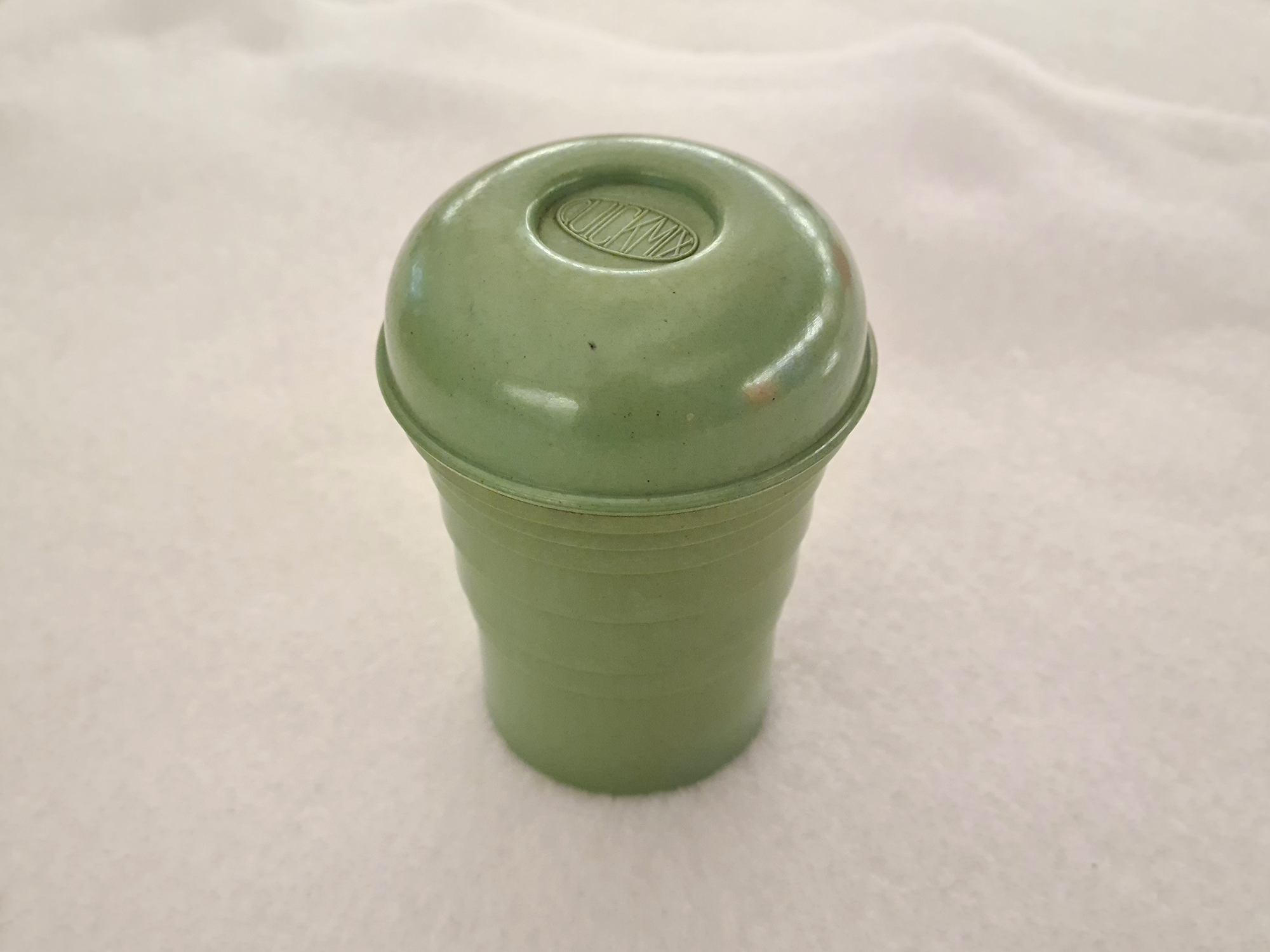
The Green Thing

https://www.modip.ac.uk/artefact/phsl-x41. Image credit: L Dennis

This object caused a little confusion with students seeing that it might be used for mixing something but they didn’t know what it could be. It reminded some of a dog treat toy, others were expecting that it might be squeezed to dispense the contents. It was not until they picked it up that they found it to be made of a very rigid material. They also discovered a patent number and additional information on the base which could have been used to find out more about the design developments that were on display here.


The Bag

https://www.modip.ac.uk/artefact/aibdc-008171. Image credit: L Dennis

The bag was laid down on the table and it wasn’t clear how you would carry it. Once the students started to handle it they found it to be a rucksack or backpack and they could see the continued use of seatbelt material on the back panel. By exploring the catalogue record the students also discovered that the bag itself is made from airbags. We thought about who the bag might appeal to with one group describing some very specific characteristics of the kind of individual who would use it.


The Hat

https://www.modip.ac.uk/artefact/aibdc-008192. Image credit: L Dennis

The helmet looks like a classic steel helmet from the 2nd World War. It is, however, made of phenol formaldehyde and has a lovely moulded inscription showing the manufacturer’s name not seen until it was lifted. The weight of the hat was also a surprise being much lighter than the students had anticipated.


The Cassette

https://www.modip.ac.uk/artefact/aibdc-007911. Image credit: L Dennis

Poor Elkie Brooks. No one chose to look at the cassette. I am not sure if this is because they knew what it was or because they didn’t. I included it because it is full of information that can help to start a thread of research that will tell us more about the object itself, as well as the time period it has come from.


These sessions help participants to foster research skills into objects. If you would like to bring a group to explore objects in MoDiP, whether you are part of the AUB or not, please do get in touch.

Louise Dennis, Curator of MoDiP

Wednesday, 15 September 2021

Worshipful Company of Horners visit

MoDiP has been caring for the collection of the Worshipful Company of Horners for the past eleven years. These objects provide a comprehensive insight into the use of one of nature's plastics; defined as being a material that can be moulded with the application of heat (in this case with a soft flame or by dipping in boiling water or hot oil) and/or pressure (eg. using a press), in its natural form. By using techniques such as cutting, sanding and polishing, the material can be used to create a wide range of products.


Whilst horn artefacts have been found that date back to the 5th century BCE, its biodegradable nature has resulted in under-representation within the archaeological record. For example, evidence of horn working is commonly identified by the remains of the hard, bony inner cores (removed from the keratin outer layer which can then be worked), and metal fittings are often all that is found to indicate the presence of early drinking horns. However, it is historically recognised as having been a widely available and relatively cheap material that was commonly used for the production of everyday items, essential tools, weapons as well as decorative objects.


A selection of horn artefacts from the Worshipful Company of Horners’ collection.
Image credit: MoDiP

The first historic reference to the Worshipful Company of Horners was recorded in 1284, identifying it as a Livery Company with powers to control the craft within the City of London such as regulating conditions of employment and setting standards for workmanship. In 1476 they merged with the Bottlemakers, originally makers of leather bottles whose trade was being eroded by the introduction of glass and, as the craft of working with horn later declined, the Company adopted the emerging plastics industry in 1943, the two industries sharing many similar production techniques.


A 17th century leather
costrel (left) and modern replica.
Image credit: MoDiP

Their extensive collection of items made from horn ranges from simple agricultural tools such as drenches for use with cattle to sophisticated pressed and pierced combs as well as horn-working tools that demonstrate how the trade gradually became mechanised. Their earliest piece is a shoe horn dated to 1612, engraved with floral and geometric designs and bearing the legend 'Robart Mindum made this shooing horne for Ricard Gibon anno Domini 1612’. 


The objects laid out for the Horners to view.
Image credit: MoDiP


Recently, MoDiP travelled to a local hotel with a selection of these objects to meet with members from the Company. This was a postponed visit due to the Covid-19 lockdown and whilst we had hoped the group would be able to join us at the museum, current restrictions on visitor numbers unfortunately meant that would not be possible. So, if they could not come to us, we would go to them and we duly borrowed a van to carefully transport the objects a few miles down the road.

We spent the afternoon examining the collection in detail and a few favourites included: a set of six beakers, graduated in size to stack inside one another and dated to c.1910, a collapsible beaker in black and cream horn, an early 19th century engraved beaker depicting a hunting scene and a leather Black Jack with silver mounts, c.17th century. All seen in the image below. 


Cups and snuff boxes.
Image credit: MoDiP


The hornbook (seen below at the top of the table, centre) was also of particular interest. From the mid-sixteenth to the late nineteenth century, hornbooks were used as a teaching aid for children and were referred to as a primer. This example consists of a sheet of paper containing the alphabet and the Lord’s Prayer, protected by a thin layer of transparent horn and mounted on a leather covered oak frame with a handle. It is stamped with a figure of Charles I on horseback on the reverse.


A selection of cutlery, combs and the hornbook.
Image credit: MoDiP


The entire collection is housed at the museum and is available for research. It can be viewed in person on request or viewed via the on-line catalogue.

Katherine Pell
Collections Officer