Showing posts with label Materials identification. Show all posts

Wednesday, 12 July 2023

Salter 59 kitchen scales

Once again flicking through the trade journals in our collection and recognising an object that we own has enriched our record with a wealth of information.  This time I was looking through an edition of British Plastics from February 1955 and I stumbled across a fabulous article about the manufacture of the Salter 59 kitchen scale.  This article has offered up a firm date and title of the object and some fabulous detail about how exactly the case was made and who did the moulding.

Salter 59 kitchen scales, AIBDC : 0_2337

Here is the article:

Three polystyrene mouldings for domestic scale

A great deal of progress has been made lately in the application of plastics to household appliances, especially where streamlined shape, appearance and ease of cleaning are essential properties. This recent trend is exemplified in the modern domestic scale where a number of new or redesigned models have plastics components; in particular polystyrene finding favour on account of the excellent finish obtainable with this material.

The Salter 59 scale uses high impact polystyrene for its scoop, general purpose for the housing, and general purpose for the dial cover, where the glass-like transparency of the material is of special advantage. The moulding is carried out by E. Elliott, Ltd. Birmingham, and the technique used to mass-produce three items mentioned is of additional interest in that all of the finishing, apart from a cementing operation, is carried out at the press.

The pictures on these pages (come and see the article if you would like to see them all) show the stages in moulding the Salter 59 case. Production is carried out on an 8-oz injection machine, using general-purpose polystyrene in a cream (yellow in our case) shade. Injection is at the centre top of the case where a square aperture is later punched out to accommodate a plunger when the scale is assembled.

Punching the square aperture from the housing after moulding, and, right, a housing placed in the jig for drilling in four positions


The circular aperture in the housing is produced by having a blank face on the mould (which closes on a bevel positioned half-way across this blank face); another interesting feature is the method of producing a slot at the rear of the housing by moulding a projection running on a taper.  Purpose of this slot is to accommodate a knurled wheel which allows the scale to be set (and reset) to zero.  About 55 lifts an hour are achieved, the cycle time being closely integrated with the finishing time. Weight of the shot as it comes of the machine is about 5 ¾ oz.

At the completion of each cycle the operator clips off the sprue and stamps out the square aperture on an electrically heated punch, the temperature of which accurately maintained by a Sunvic control system.  After this the housing is placed in a jig, which is designed both to hold the shape of the moulding as it finally cools and to allow the simultaneous drilling of four 1/16 in holes, two on each side; the purpose of these holes is to accommodate attachment of the inner mechanism of the scale. Drilling is carried out by four drills each operated by an air valve supplied from the normal press air line; a master valve enables the complete system to be switched in and out, and thus cutting out noise when the drills are not actually operating, and thus making the operator's job less fatiguing. The housing then wrapped in tissue and at once packed in a cardboard box for transfer to the Walsall works where the moulding dial cover cemented in.

Production of the dial cover is carried out on a 4-oz machine, using single-impression three-plate tool working with clear transparent material. Gating is at the centre of the cover, and to disguise the tiny scar at this point the mould is blasted over a small circular area, thus producing circle of matt finish in the centre of the cover when moulded. Weight of shot is 1 ½ oz. Removal of the sprue is interesting in that a tapered dowel provides a positive movement of the sprue in the tool, so that  after the stripping plate has cleared the moulding , the sprue can be removed backwards from the gate.

The dial covers are wrapped tissue and packed straight from the press and, as previously stated, sent away for cementing into the housing. Thus the handling of both is reduced to the barest minimum, thereby cutting down the possibility of rejects through accidental damage in the factory.

The scoop of the scale is run alternately with the housing.  A single-impression tool is used and the scoop is gated on the centre under-surface. The colour used is cream, and the weight of the shot is just over 3 ½ oz. The sprue is removed from the operator, who then packs the scoop in similar fashion to the housing. The scoop is embossed to provide graduations in fluid ounces and pints on the inside.

It is so interesting to see the number of different steps needed and the care given to the end product to ensure it arrived at its destination in good order.  I do love finding these fascinating articles.

Louise Dennis, Curator of MoDiP

Wednesday, 3 May 2023

Reuse: Black plastics

One of the cases in our current exhibition, Reuse, looks at the problems that black plastics have when it comes to the recycling system and therefore how the material is then reused.

When products and packaging made of plastics enter the recycling system, they need to be separated into individual materials, for example PET, HDPE, or PP, so that they can become useful recyclate. In automated systems, this is done using a Near Infrared (NIR) Identification system. A beam of light is shone at the material and interacts with the chemical compounds of the waste; the light will either be absorbed or reflected across a spectrum of wavelengths providing a signature for the material. Black plastic products are not able to be sorted using the NIR device because the carbon black pigments absorb all of the light, making it impossible to see the signature of the material. As such black plastic packaging is often rejected for recycling.

Voet, V., Jager, J., Folkersma, R., 2021. Plastics in the Circular Economy, De Gruyter graduate. De Gruyter, Berlin & Boston. P231

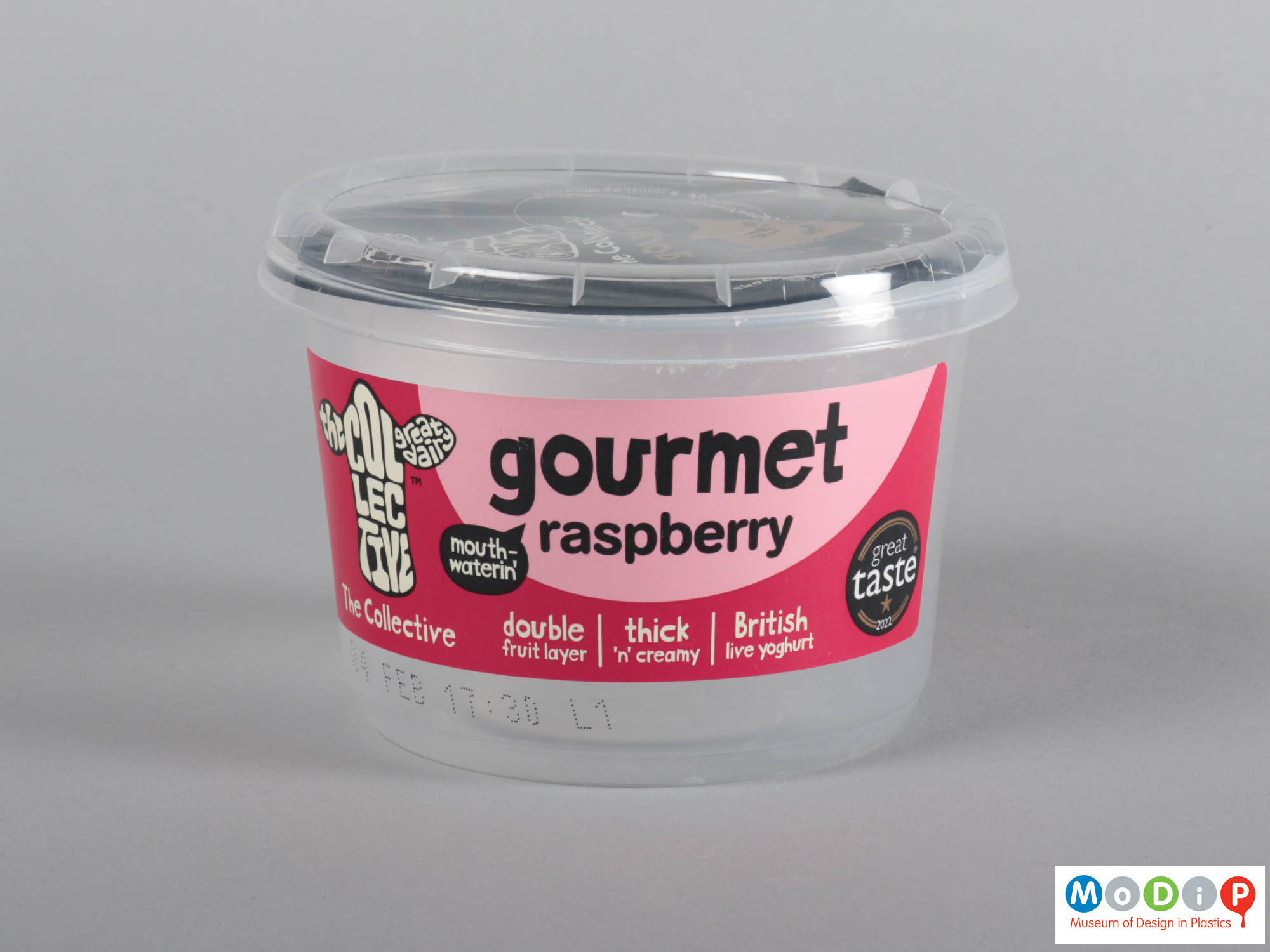
Because the black pigments make it difficult to identify the materials much work has been done to discover create other pigments that still keep the black colour for brands to use in their packaging.  In 2018, Gourmet Dairy Brand, The Collective worked with recycling experts Nextek Ltd and the South Wales-based additive and masterbatch specialist, Colour Tone, to develop a new black masterbatch.

The result was a revolutionary colourant technology that enables the effective detection and sorting of black plastic waste for recycling into high quality materials.  If other fast-moving consumer goods (FMCG) producers were to follow The Collective’s lead, it could have helped to reduce the 1.3 billion black single-use food pots, tubs and trays that are sent to landfill each year – around 30,000 tonnes.[1]

From October 2018, the black lids on The Collective’s 450g and 900g yogurt tubs featured the new NIR reflecting colourant to help ensure that the consumer recycling efforts do not go to waste.  The Collective says that it is ‘very proud to be leading the change’ on the recyclability of black plastics and that it is the first food and drink brand to launch a special detectable black lid. 

The Collective Great Dairy Yoghurt potAIBDC : 008198

This process was all part of the food producer making a brand promise to go cleaner by encouraging everyone to ‘eat better. do better.’[2] Other actions by the company included making the UK’s 1st carbon neutral dairy yoghurt in September 2021 and committing to making all our products carbon neutral by 2025.

Unfortunately, the company found that the recycling system was not yet in step with the changes they had made.  The black lids had to be replaced in May of 2021 with clear alternative because it was found that consumers had become used to discarding the lids into general waste and recycling centre staff, unaware of the change, continued to remove the black plastic.

The Collective Gourmet Yoghurt potAIBDC : 009565


Louise Dennis
Curator of MoDiP 

[1] ‘When Black Is Green: Yoghurt Manufacturer Takes on Sustainability Challenge’, British Plastics and Rubber, Nov / Dec, 2018, 25.

[2] The Collective, ‘Going Greener’ <https://thecollectivedairy.com/going-greener/> [accessed 12 December 2018].


Wednesday, 5 October 2022

Curator or Detective

There is no better feeling than finding an important nugget of evidence about an object, even if it proves we have got something wrong.

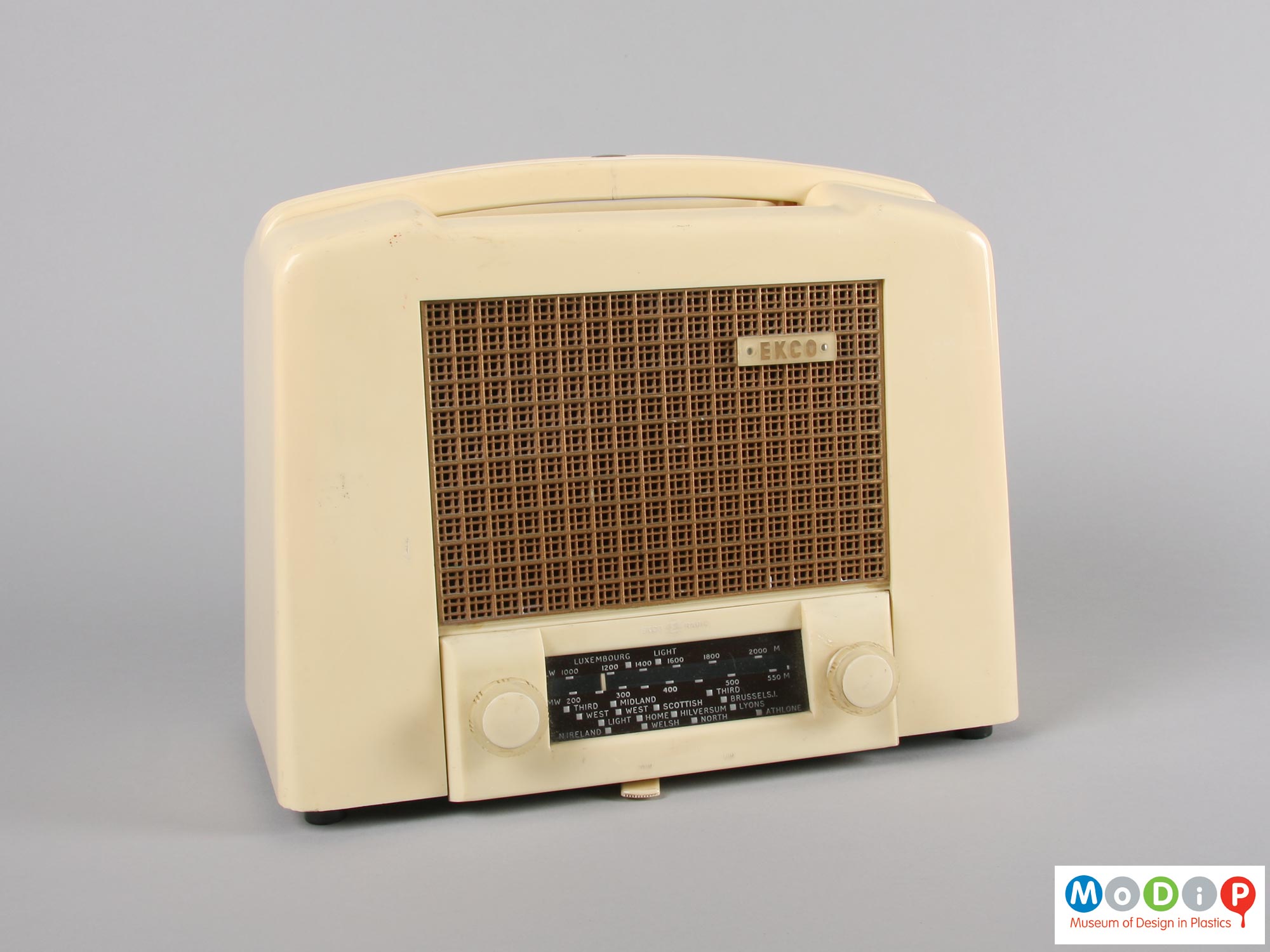
Ekco U122 radio, 1950.  https://www.modip.ac.uk/artefact/aibdc-002557


Due to its age and colouring we had assumed, incorrectly, that the above EKCO U122 radio was made of urea formaldehyde. I was so pleased to have come across an advert placed by E. K. Cole Ltd, Plastics Division, in an edition of the trade journal ‘British Plastics’ from August 1950 which featured the very radio.  It proved to me that we had made a mistake - and that the case is actually made of polystyrene.

Advert for E. K. Cole Ltd, Plastics Division.  British Plastics, August 1950.


The text in the advert reads:

A good all-rounder
EKCO - pioneers of the plastic radio cabinet - design, tool and mould for many of the leading Radio Manufacturers. This particular example is a one-piece injection moulding in polystyrene, 1/8 inch thick, with a projected area of 72 sq. in. The carrying handle is moulded in, and conical tapered ribs are set in each corner for additional strength and rigidity. At the edge of each rib is a brass insert to take fixing screws. The all-round finish, colour and completeness of the cabinet is an excellent example of the moulder’s art - and further proof of our ability to serve industry.

Some additional points of interest

This polystyrene injection moulding is produced in three colours - ivory, green, and maroon on a 32-oz press, the minimum size required for a moulding of these dimensions. The apertures at the front, back and beneath the handle are for attachments of specially moulded lattice grilles which are permanently fixed into position by suitable solvents, this saving the incorporation of inserts or the use of fixing clips etc. When drilled, the injection port provides ideal location for the fixing of a boss carrying a trade mark.

In addition to the cabinet itself Ekco mould the lattice grilles, control knobs, daikon scale, trade mark and feet. The remarkably fine ‘all-round’ appearance of the receiver is due to a combination of brilliant design and technical skill.

E K Cole Ltd was obviously proud of their workmanship. The following edition of the British Plastics journal (September 1950) carries an article about the same radio with some technical details of how the case was moulded, taking care of how it cools after moulding. The details of both the advert and the article, which are contemporary to the radio itself, have now informed the catalogue record on our website which is more accurate.


An image from the MoDiP collection showing the case being drilled. https://www.modip.ac.uk/artefact/bxl-0856


MoDiP has a number of radios of various ages in the collection along with an almost complete run of British Plastics magazines from 1931-1972 all of which can be viewed on request.

Louise Dennis, Curator of MoDiP
Wednesday, 28 September 2022

Festival of Plastics

Earlier in September we attended the Festival of Plastics, held at the Museum of London.  This festival was a celebration of the COMPLEX project which was coming to an end after five years.  The project, run by UCL’s Institute for Sustainable Heritage, received funding from the European Research Council under the European Union’s Horizon 2020 programme (No 716390).  Our Chief Curator, Susan Lambert, has been a member of the project's steering group and we have been fascinated by the activity of the project from the beginning.

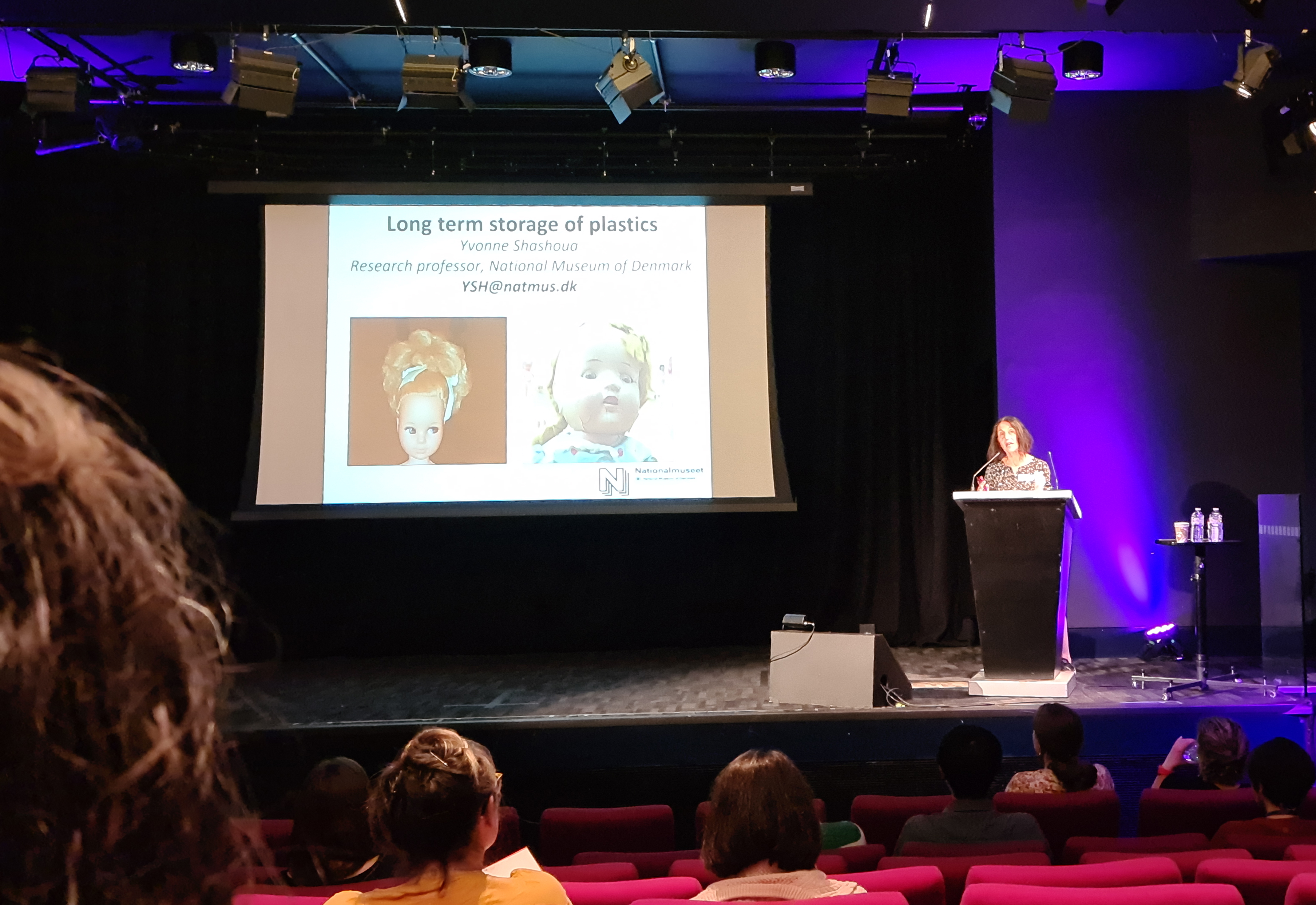
The festival included fascinating talks from a variety of speakers including a keynote from Yvonne Shashoua on the ‘Long term storage of plastics’ which was really interesting.  Yvonne wrote the seminal book ‘Conservation of Plastics’, a book we refer to regularly, so it was great to hear her talking on the subject again.


Yvonne Shashoua talking about the ‘Long term storage of plastics’. 
Image credit: Louise Dennis


We were not there just as observers.  Susan contributed a pre-recorded presentation about the project ‘A curator’s guide to synthetic garments’ which MoDiP has managed as part of the Plastics Subject Specialist Network (PSSN) alongside the Dress and Textiles Specialists (DATS).  The guide's purpose is to enable participants to improve the documentation and interpretation of collections of synthetic garments and to act as a stand-alone guide for basic synthetic textile identification.  It can be used alongside the other PSSN resources (A curator's guide to plastics and Confronting plastics preservation) to develop a fuller understanding of the various materials and their needs.


Susan Lambert's presentation about synthetic garments. 
Image credit: Louise Dennis


We also had a stall which offered us an opportunity to talk to delegates about MoDiP and the resources that we can offer to museums and other interested parties.  We took along objects from the Identifying Plastics Toolkit https://www.modip.ac.uk/projects/toolkit which caught the eye of the Institute of Conservation Modern Materials Network (ICON MMN) - thank you for the nice comments on Twitter guys, we aim to please.


A lovely tweet from ICON MMN.
Image credit: Fabiana Portoni


We found ourselves rather conveniently situated next to the UCL table, where there was an array of equipment on display and some amazing PhD students demonstrating how to identify different plastics materials using Fourier-transform infrared spectroscopy (FTIR).  Seizing the opportunity, we were able to analyse some of MoDiP's objects which we just happened to have bought with us (anyone would think this was pre-planned!).  We also bombarded the UCL team with questions as research for a project we are hoping to develop to test the rest of our collection.  Big thanks to Dr Katherine Curran, Louise Garner and Saya Miles for all of your help with this and apologies for monopolising so much of your time!


Katherine having a go at External Reflectance FTIR.
Image credit: Louise Dennis


Lastly, Louise also represented the museum during the panel discussion at the end of the day. She was flanked by Yvonne and Susan Mossman, Chair of the Plastics Historical Society, and joined by some of the other speakers from UCL and Tate.  This rounded off a great day full of interesting talks, networking and fact-finding opportunities.


Louise on stage for the panel discussion, second left.
Image credit: Katherine Pell.


Louise Dennis, Curator of MoDiP, and Katherine Pell, Collections Officer.

Wednesday, 16 February 2022

Gutta percha

When I joined MoDiP, this beautiful ornament captured my attention. It is currently on display in the About Plastics case in the museum.


Initially, I was confused. What was a wall ornament doing in MoDiP? I made it my mission to research this beautiful artefact.

I found out that it is a wall plaque of Venus and Cupidmade from compression moulded gutta percha and a chalk/flour mix, painted black. It dates to the late 19th century.

Gutta Percha is a natural plastic from the latex of several Malaysian trees which belong to the Sapotaceae family. The milky substance emitted is called Gutta Percha when it is evaporated and it is a hard material at room temperature, becoming soft at 100°c. It was first introduced into Europe in 1843 and was widely used as electrical insulation in underwater telegraph cables like this one from MoDiP's collection.


A few other objects in the museum that contain Gutta Percha include a lovely sample (bottom left), a pen tray (bottom middle) and a gaming piece (bottom right).


If you would like to come in to see these items or any other objects we have, contact us here.

Reanna Butcher
Museum Assistant

Wednesday, 29 December 2021

Input 14 ice bucket, Martin Roberts, 1973

I love the vibrant green colour of this ice bucket (AIBDC : 008800), a rather appropriate object for this time of year as we get ready to toast in 2022.


Image ref: The ice bucket, showing the white, removable liner (right).
Image credit: Katherine Pell


I also love the design of the lid. It has three indented circles for finger grip and reminds me of a button.

Image ref: External and internal view of the lid.
Image credit: Katherine Pell


Designed by Martin Roberts for Conran Associates and manufactured by Crayonne Ltd, the ice bucket was part of a range of 21 brightly coloured, heavy-duty plastics containers sold through Habitat. First launched in 1973, the Input series was created to be interchangeable, with the same height and diameter used throughout, and included trays, bowls and vases with an assortment of lids and insulating liners.


Image ref: The Input series consisted of 21 different numbered, interchangeable, containers.
Image credit: 
http://www.objectplastic.com/2014/01/input-11-container-conran-associates.html


Originally available in red, yellow, green or white, additional colours were added later and none of the pieces were named but instead given a number. The ice bucket was referred to as Input 14 and is made from polished acrylonitrile butadiene styrene (ABS), chosen for its scratch and shatter resistance, with a polyethylene (PE) liner. Injection moulded, the bucket wall was designed to be almost twice as thick as comparable products on the market (refer image below).


Image ref: The robust wall of the ice bucket (left) and the manufacturer’s mark on the underside (right).
Image credit: Katherine Pell


Crayonne was a subsidiary of Airfix Plastics, set up in 1972 to try to improve the image of the plastics material. They approached Conran to apply high design principles to everyday homewares with the successful Input range going on to win the 1974 Design Council Award for Contract and Consumer Goods – the entry description is provided below.


Image ref: 1974 Design Council Awards, Containers by Numbers.
Image credit: 
https://www.vads.ac.uk/digital/collection/DIAD/id/6601


1974 Design Council Award for Contract and Consumer Goods.

Containers By Numbers Input Range heavy duty abs resin containers. Made by Crayonne Ltd, 81 Windmill Road, Sunbury-on-Thames, Middlesex. Designed by Conran Associates. Approximate retail price: 85p to £4 05 ex VAT.

Two years ago, Airfix Plastics, one of Britain's biggest injection moulding companies, initiated a design programme aimed to give plastics the kind of improved image already well established on the continent. The company approached Conran Associates, design subsidiary of Habitat, with a view to jointly producing a range of products for the home or office. A happy association between the two companies was soon formed and in May 1973 the Input range was launched, designed by Conran Associates for Crayonne, a newly formed division of Airfix.

Research had shown that everybody needed 'something to put things in' and these things could be anything from fruit and flowers to pencils and paper clips. The Input range consists of 21 such 'containers', all made from heavy duty abs plastics. This material was chosen for its strong, solid finish and its scratch and shatter resistance. A particularly low-rate injection moulding cycle enabled the units to be made nearly twice as thick as other abs products, adding to the impression of solidity.

The range is built up logically, all units being based on the same diameter and height ratios, which gives them an integrated quality. There are bowls, dishes, trays, vases, pots, and an ice bucket; some have lids and some are open; they are fitted with different ceramic, melamine and insulating inserts. None of the units is named; each is simply given a number, so that the buyer can use it for whatever purpose he wants. Colours are bright red, yellow, green or white. All items are packaged for the gift market: each one comes gift-boxed, according to the corporate image created for Crayonne by Conran Associates, which includes packaging, graphics, point-of-sale and catalogue material.

One order of which the company is very proud came from the Royal Free Hospital which wanted a large supply of Inputs to be used as vases to brighten up their wards. The Input range is only the first of a series of products planned by Crayonne. Soon to be launched is a range of bathroom fittings this time in pastel colours. Input has already won the Living Award for Good Design (sponsored by Living magazine in conjunction with the Design Council).


Image ref: The launch of Input, left to right: Ralph Ehrmann (Chairman and Chief Executive, Airfix Industries), Terence Conran (Chairman, Habitat) and David Sinigaglia (Managing Director, Airfix Industries).
Image credit: Forty Years of Airfix Toys by Jeremy Brook


MoDiP has another example of this ice bucket in
red, a smaller container, the Input 10 (essentially the Input 9 vase/storage tub with a lid), a bathroom jar that was part of the second range of colours introduced by Crayonne, as well as some of the bathroom fittings referred to above. These were all recently donated to MoDiP by Zack Wyse and I shall be including other objects from his collection in future blog posts soon.


Image ref: Other MoDiP examples of the Crayonne Input series.
Image credit: Katherine Pell


Katherine Pell
Collections Officer


Wednesday, 8 December 2021

MoDiP's new Museum Assistant

Hello, you may be wondering who I am. So, first a bit about me…My name is Reanna, I grew up in a relatively large family and I went to college and studied photography for 4 years. I joined MoDiP in November 2021 as Museum Assistant. I decided to join MoDiP to develop my knowledge on everyday plastics and because of my general curiosity with this material.

When most think of plastics the first thing that might spring to mind could be crisp packets, water bottles, yoghurt pots and many more food packaging products, right?


Image ref: clockwise from top left: AIBDC : 005662, 007994.1, 007145 and 005677
Image credit: MoDiP


Well, what if I was to tell you that the clothes you are wearing could be plastic? Mind boggling! How can clothes be made of plastics? These are the sorts of things I would like to learn more about.

Image ref: clockwise from top left: AIBDC : 003686, 005965, 004256 and 001720
Image credit: MoDiP


So many of us lack a real understanding of plastics and that’s why I am here, to broaden my knowledge as well as my workplace experience. I am positive that during my time here I will learn many new things and I hope that by reading this post you might be inspired to find out more too.
 
Reanna Butcher
Museum Assistant

Wednesday, 24 November 2021

CC41 Utility blouse

A recent workshop provided the opportunity to look a little closer at a number of synthetic garments in MoDiP’s collections, and this blouse (refer image below) particularly caught my attention.


AIBDC : 000824
Image credit: MoDiP


It is very popular and gets used for research by students and teaching by staff every year but we know very little about it. The original catalogue record simply stated:

A Utility mark labelled blouse with three-quarter length sleeves, popper front fasteners and shoulder pads. Size 44. The fabric is a multi-coloured print based on the traditional paisley design.


The CC41 Utility label
Image credit: Katherine Pell


The blouse has a CC41 Utility label (refer image above) that includes the number 1051/2. I found a book that explained that the four-figure number denotes the material as rayon (numbers 1000-1206) with the 2 indicating that the blouse was originally sold as part of a two-piece set. However, a conversation with AUB’s Sarah Magill (Course Leader BA (Hons) Costume and BA (Hons) Performance Design and Film Costume), provided some additional information. She was able to show me a page from the Statutory Rules and Orders for cloth 1942, that listed the rayon specifically as Marocain (crepe) and explained that the suffixes were brought in to differentiate between finishes: /1 referring to a dyed fabric; /2 referring to a printed fabric.


Statutory Rules and Orders for cloth, 1942
Image credit: Sarah Magill


Although clothing from this period is often thought of as being drab, it is evident by this blouse that there was still lots of colour. The busy pattern could be easily joined together without matching up, thereby reducing material wastage which was important in those times of austerity. Interestingly, one of the shoulder pads has a completely different material patch on the underside (refer image below).


The unmatched patch can be seen at the top of the shoulder pad.
Image credit: Katherine Pell


The blouse has three-quarter length sleeves, with popper front fasteners beneath five false buttons. I was able to find out that the Civilian Clothing (Restrictions) No. 6 Order (dated 20/06/1942), introduced rules that blouses could have no more than seven buttons and buttonholes on a full-length sleeve style or five on one with shorter sleeves. Whilst the number of buttons on MoDiP’s example met this requirement, the spacing of them is incorrect and false buttons were actually prohibited within the restrictions of 1942 – 1946. 

Furthermore, press-studs would likely have been unavailable during that period as the metal would have been diverted for military use (as it was for zips). It is possible that old stock might have been used or alternatively, the blouse could be post-war, dating from 1946 – 1952 when the Utility clothing scheme ended. To further complicate matters, Sarah advised that evasion of the rules was rife!

We think the blouse is poorly stitched, not particularly straight in places and the tension is not good either. This leads us to believe that it is inconsistent with being factory made for sale in a shop, which is what we had originally believed. It possesses clear 1940s styling through the fit and the roll collar, with the shoulder pads providing the square silhouette that was popular at that time, but the seam allowances appear too generous.

The more we examine this object, the more questions we have about it so I can’t wait for Sarah to come into the museum to study the construction (she has kindly agreed to come in and help us). We have a sneaking suspicion that it may have been altered from a different original garment, but whether that was during the era of ‘make do and mend’ or post-war we are not sure. Hopefully Sarah will be able to answer some of these anomalies.

If you want to view this blouse and let us know what you think, contact us to arrange an appointment.

Katherine Pell
Collections Officer

Wednesday, 13 October 2021

AUB Materials Library

As you may know MoDiP is situated in the AUB Library, what you might not know about is another fantastic resource that resides in same building, the Materials Library https://aub-uk.libguides.com/collectionspages/materialslibrary 

The Materials Library. Image credit: Louise Dennis

You can find out more information by scanning the samples. Image credit: Louise Dennis

The drawers of intrigue.  Image credit: Louise Dennis

The AUB Materials Library is a collection of new and innovative product samples including ceramics, plastics, glass, paper, metal, timber and much more.  The purpose of the collection is to inspire and offer ideas in support of creative practice, as well as providing a knowledge of materials, their properties and applications. Each material sample in the Library features a unique QR code that can be scanned into the software. Scanning the QR code opens an information data sheet for the material, including its location within the Materials Library and links to the manufacturer’s website.

A few of the materials samples. Image credit: Louise Dennis
 
A glittery acyrlic sample.  Image credit: Louise Dennis

A selection of samples. Image credit: Louise Dennis

It is easy to get lost down a rabbit hole of curiosity just by pulling open a drawer and having a rummage.  For obvious reasons I gravitate towards the plastics materials but you soon drift away to something else.  If you are visiting MoDiP, I would heartily recommend a wander to the far corner of the ground floor of the building and having an explore.  

Louise Dennis, Curator of MoDiP