I am a third year Architecture student at AUB, and have been given the opportunity to promote the Museum of Design in Plastics. My project with MoDiP seeks to explore and revive the connection between plastic products and their source – the fossil.
As a student of Architecture I like to produce work that is more conceptual – something that gives the viewer a narrative or idea, and hopefully evokes emotion or thought. I want to juxtapose the ‘synthetic’ portrayal of plastics today against the aesthetics and properties of fossils.
In the last blog post, I stated that I would have to learn a new 3D modelling program, and learn how to 3D print. The former was actually unnecessary – a program that I am already familiar with, SketchUp, can be used for 3D printing when various plug-ins are installed for it. Learning how to 3D print, however, has been a very interesting and informative journey. This blog post will be heavily condensed for your convenience – the journey towards the final piece has been very long and arduous!
To 3D print something, you must have your chosen object as a digital 3D object. I used SketchUp to make an ammonite from scratch. This way, I would be crafting an entirely original product, using my skills in digital modelling to make up for my inexperience in manual modelling.
 |
| SketchUp modelling, Adrian Finn, 2017 |
The
image below is of my first ever 3D print. As you can see, the quality
of the print overall is low. The tentacles did not print as I intended,
which caused the lower part of the object to print incorrectly. A couple
of prints similar to this helped me to conclude two major points in the
design: aesthetically, the ammonite needed a shell which looked more
like an ammonite and less like a snail. Practically, the ammonite would
have to be printed in separate parts and assembled.
 |
| First 3D print, Adrian Finn, 2017 |
Around this time, I was very fortunate to be loaned a 3D printer to take home over the Easter holidays. I’d like to thank the AUB Interior Design staff for their continued help (and patience!) with me turning up daily with new models to print, and all of the questions that needed answering to constantly improve my skills over time.
The model kept improving over time, with many prototype prints and tests being conducted from home. Many adjustments were made as I had to work out how pieces would fit together. As well as this, I had to design the components to be printable – the digital object couldn’t have gaps in its surface, and each piece had to be designed in such a way that meant a printer could generate it from top to bottom.
 |
| 3D printing at home. |
 |
| Digital modelling, Adrian Finn, 2017 |
A program called Cura, distributed by the same company that produces the printers I was using (Ultimaker), takes the 3D file you make and simulates how your model will look on the printer. You can then change settings to control how the printer prints, and to what level of quality you would like.
 |
| Using the Cura software |
 |
| 3D printing in action. |
After many iterations of the ammonite, and lots of time carefully gluing delicate pieces together, I was finally satisfied with a final product. However, I wasn’t happy with the printing standard achievable with the university printers. I took my model to a professional 3D print studio in Southbourne called The 3D Print House, where I could have my digital creation printed to a professional quality.
 |
| The 3D Print House, Southbourne |
Here I met Mike Beaman, who explained to me a lot behind the process of 3D printing. He advised that I print with the ABS (Acrylonitrile butadiene styrene) plastic, as it is a plastic derived from crude oil. This information was essential to my project’s core concept, and truly helps the project to express the message behind it.
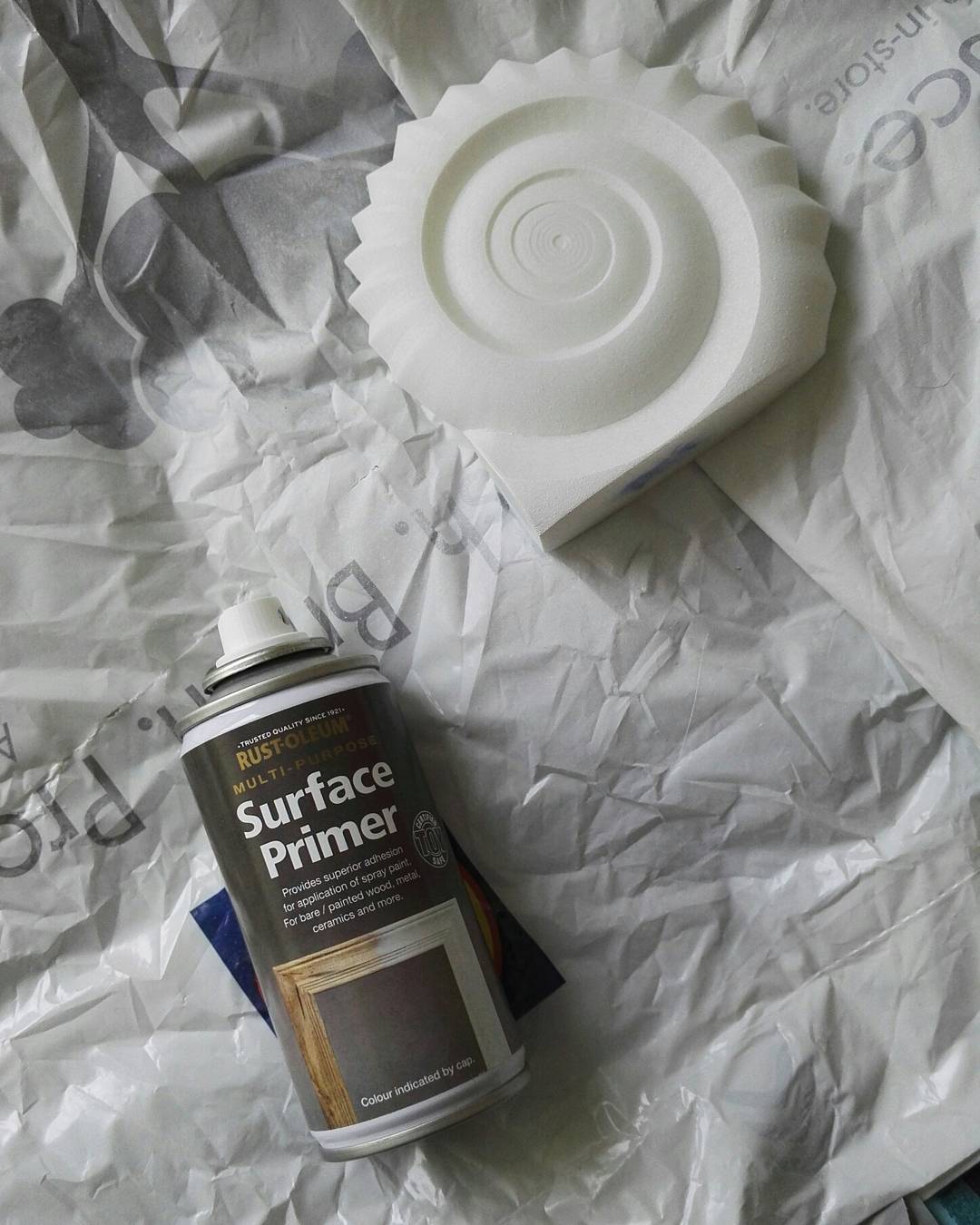
With two ammonites collected from the 3D printers, and one printed with the university’s resources, I was close to having the final trio of works. One was being primed for painting by the talented Zoe Benham, and the other two were assembled (one has been caught in the act of attacking Poole civilians… on a scale model produced by myself last year):
 |
| The black ABS model. The colour finish reflects crude oil. |
 |
| The white ABS model, primed for Acrylic paint. |
 |
| The purple PLA model. PLA is a plastic derived from vegetable oil. |
For the white ammonite, I wanted Zoe Benham, a third year AUB Textiles student, to paint the model with acrylic paint to highlight and celebrate the versatility of plastic as an outlet for creativity. Zoe had been following the project closely throughout, and was aware of the brief. I was curious to see how she would interpret my work.
And finally, here we have the final pieces of the MoDiP Student Creative project:
 |
| PLA Ammonite, Adrian Finn, 2017 |
 |
| ABS Ammonite, Adrian Finn, 2017 |
 |
| ABS Ammonite, Adrian Finn in collaboration with Zoe Benham, 2017 |
Zoe’s interpretation of the brief was stunning. Detailed photos show her use of fluorescent acrylic paint, the layering of paint to give a texture to the shell, and the change in technique of how the paint is applied.
 |
| ABS Ammonite, Adrian Finn in collaboration with Zoe Benham, 2017 |
I
would like to thank the MoDiP staff for making this project possible
through funding and support for the Student Creative scheme; the 3D
Print House for their services and advice; Zoe Benham for producing a
beautiful finish to the last ammonite; the Interior Design staff for
putting up with my constant badgering for help.
 |
| Ammonites, Adrian Finn, 2017 |
 |
| The work has been displayed in the AUB library |
If you are interested in keeping up to date with my work, and seeing how 3D printing influenced my Final Major Project, please visit my Facebook page at https://www.facebook.com/AdrianFinnCreative/
A professional portfolio will follow soon, so watch that space!
Thanks for reading!
Adrian Finn
Student Creative
BA (Hons) Achitecture