MoDiP has been closed over the summer whilst we moved into our new location. We are now open and have a great exhibition for you to visit.
Spotlight on... 2
This is the second in a series of exhibitions that puts the spotlight on
manufacturers and designers who embrace plastics as a material of
value.
Mass produced anonymous plastic products flood the market. Many have
no maker or designer’s name attached, the result being that the popular
perception of such objects is that they are of low cost and low quality.
However, in stark contrast, many designers and companies have exploited
this versatile material, used it to great effect, and are proud to put
their names to it. As materials and manufacturing technologies have
evolved, designers have begun to realise the possibilities it offers and
have created objects that have come to be regarded as design icons. Consequently, many objects made from plastics materials are now to be
found in major museum collections across the world and, although
produced in quantity, such objects are held in high regard.
In this exhibition, we explore the works of designers such as Zaha
Hadid and Verner Panton, and manufacturing companies including Kartell
and Materialise
We hope you enjoy your visit.
Louise Dennis (Assistant Curator)
Thursday, 19 October 2017
Monday, 16 October 2017
BXL photographic archive #0135
In
2010, MoDiP was donated a large archive of images relating to a single
company. Bakelite Xylonite Ltd, also known as British Xylonite Ltd or
BXL, was possibly one of the first British firms to successfully
manufacture a plastics material in commercial quantities. The company
was established in 1875 and after a long history went into liquidation
in the late 2000s. The images we have in the collection are concentrated
around the 1960s through to the 1980s and show us glimpses of the
manufacturing process, products and the company’s employees during this
time. We plan to share an image each week to give a flavour of the
archive. If you want to see more you can view the whole collection on
our website.
This week’s image shows an aerial view of the Bakelite factory in Ware.
We
are still working on the documentation of the archive, some of the
images we know more about than others. It would be fantastic if we could
fill in some of the gaps in our knowledge, if you know anything about
the company or specific images it would be good to hear from you.
Louise Dennis (Assistant Curator)
This week’s image shows an aerial view of the Bakelite factory in Ware.
![]() | |
| To get a better view of the image and find out more have a look at it on our website http://www.modip.ac.uk/artefact/bxl--1568 |
Louise Dennis (Assistant Curator)
Friday, 13 October 2017
Horners collection
The Museum of Design in Plastics houses two collections
alongside our own. One of these
collections is that of the Worshipful Company of Horners.
Wednesday, 11 October 2017
Arts 4 Dementia
On World Alzheimer’s Day, 21 September, I attended Arts 4 Dementia Reawakening Integrated: Arts & Heritage Symposium. Arts 4 Dementia is a UK charity, founded in 2011 who promote empowerment through artistic stimulation.
They work with arts venues to provide training and develop arts programmes. They have a new re-developed website that highlights arts events that stimulate people affected by dementia in the community and Dementia-Friendly arts & heritage venues / locations.
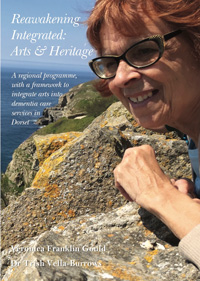
The symposium put forward engaging and thought providing notions of how The Arts can be beneficial to people with Dementia. The day began with a welcome from Stephen Wrentmore, Artistic Producer, The Lighthouse in Poole, the venue host for the day. Veronica Franklin Gould, president and founder of Arts 4 Dementia introduced ‘Reawakening Integrated: Arts & Heritage’. A regional programme, with a framework to integrate arts into dementia care services in Dorset.
A report had been produced on the first of the three year academic partnership programme, based in Dorset, to integrate artistic stimulation into NHS England’s Well Pathway for Dementia. Part I articulates on a feasibility study of which investigation is being undertaken by Dr Trish Vella Burrows - it is looking at a framework to integrate arts in dementia services. Part II discuses Arts & Heritage versus Dementia - reawakening the mind arts programme to empower people with early-stage dementia, a dementia friendly initiative to preserve the joy of cultural visiting for families affected by the condition. Partnerships were developed as part of the project with Alzheimer’s Society, Ageing & Dementia Research Centre at Bournemouth University, Arts University Bournemouth, Canterbury Christ Church University and Pavilion Dance South West.
It is fascinating to understand that arts engagement is central to healthy ageing and has a key role to play for people with dementia. It has been noted that research demonstrates how visual arts, music, dance, drama, and other cultural and heritage activities can boost brain function and social wellbeing - helping to delay the onset of dementia and diminish its severity. It’s astonishing that artistic skills and appreciation, imagination and creativity can remain vibrant for years after onset of dementia. ‘The arts embody human expression – physical evidence of the impulse to create – influencing culture, changing culture and sharing stories with a wider world’ (Dementia and Imagination, 2017).
There were many key note speakers and cases studies presented throughout the day. One particular case study caught my attention. Dorset County Museum who delivered eight free weekly drawing workshops inspired by curator-led conversations in the galleries. The workshops took place from February to March 2017, on Thursdays from 2-4pm. The project aimed to re-engage the interests of local residents, giving them a range of opportunities to revive and develop skills to help override symptoms of memory loss, restore sense of purpose and reconnect in the community. The project involved a local artist Gillian Lacey, who teaches anatomy and drawing. She is a trained nurse and had specialised in drawing and memory for her MA. She worked in partnership with curators, educators and a volunteer at Dorset County Museum.
Curators were asked to choose 3 objects or groupings of objects, an aspect of which would inspire the resulting art session. They were asked to give brief explanation about each object in order to trigger interactive dialogue among participants and inspire the art workshop.
To keep up the artistic programme at home between the sessions and after the project was completed Arts 4 Dementia supplied a sketchbook and art pencils to participants. The artist also liaised with museum staff to provide colour reproductions for reference, to enable participants to continue to develop their drawings at home in order to maximise creative inspiration.
This case study made me realise that people with dementia visiting a gallery or museum, together with family or friends are able to heighten their sense of social wellbeing, long after dementia sets in. Weekly arts sessions led by facilitators trained to override dementia symptoms allowed participants to engage their creative instincts, to revive, develop and learn skills joyfully together.
Attending the symposium has had a compelling impact. I am inspired to take the lead here at MoDiP to explore how we can deliver engagement with the museum collection, to become a Dementia- Friendly Arts Venue. Watch this space…
Sarah Jane Stevens, AMA (Museum Engagement Officer)
![]() |
| Reawakening: Integrated Arts Heritage |
They work with arts venues to provide training and develop arts programmes. They have a new re-developed website that highlights arts events that stimulate people affected by dementia in the community and Dementia-Friendly arts & heritage venues / locations.
The symposium put forward engaging and thought providing notions of how The Arts can be beneficial to people with Dementia. The day began with a welcome from Stephen Wrentmore, Artistic Producer, The Lighthouse in Poole, the venue host for the day. Veronica Franklin Gould, president and founder of Arts 4 Dementia introduced ‘Reawakening Integrated: Arts & Heritage’. A regional programme, with a framework to integrate arts into dementia care services in Dorset.
A report had been produced on the first of the three year academic partnership programme, based in Dorset, to integrate artistic stimulation into NHS England’s Well Pathway for Dementia. Part I articulates on a feasibility study of which investigation is being undertaken by Dr Trish Vella Burrows - it is looking at a framework to integrate arts in dementia services. Part II discuses Arts & Heritage versus Dementia - reawakening the mind arts programme to empower people with early-stage dementia, a dementia friendly initiative to preserve the joy of cultural visiting for families affected by the condition. Partnerships were developed as part of the project with Alzheimer’s Society, Ageing & Dementia Research Centre at Bournemouth University, Arts University Bournemouth, Canterbury Christ Church University and Pavilion Dance South West.
It is fascinating to understand that arts engagement is central to healthy ageing and has a key role to play for people with dementia. It has been noted that research demonstrates how visual arts, music, dance, drama, and other cultural and heritage activities can boost brain function and social wellbeing - helping to delay the onset of dementia and diminish its severity. It’s astonishing that artistic skills and appreciation, imagination and creativity can remain vibrant for years after onset of dementia. ‘The arts embody human expression – physical evidence of the impulse to create – influencing culture, changing culture and sharing stories with a wider world’ (Dementia and Imagination, 2017).
![]() |
| Dorset County Museum |
There were many key note speakers and cases studies presented throughout the day. One particular case study caught my attention. Dorset County Museum who delivered eight free weekly drawing workshops inspired by curator-led conversations in the galleries. The workshops took place from February to March 2017, on Thursdays from 2-4pm. The project aimed to re-engage the interests of local residents, giving them a range of opportunities to revive and develop skills to help override symptoms of memory loss, restore sense of purpose and reconnect in the community. The project involved a local artist Gillian Lacey, who teaches anatomy and drawing. She is a trained nurse and had specialised in drawing and memory for her MA. She worked in partnership with curators, educators and a volunteer at Dorset County Museum.
Curators were asked to choose 3 objects or groupings of objects, an aspect of which would inspire the resulting art session. They were asked to give brief explanation about each object in order to trigger interactive dialogue among participants and inspire the art workshop.
To keep up the artistic programme at home between the sessions and after the project was completed Arts 4 Dementia supplied a sketchbook and art pencils to participants. The artist also liaised with museum staff to provide colour reproductions for reference, to enable participants to continue to develop their drawings at home in order to maximise creative inspiration.
This case study made me realise that people with dementia visiting a gallery or museum, together with family or friends are able to heighten their sense of social wellbeing, long after dementia sets in. Weekly arts sessions led by facilitators trained to override dementia symptoms allowed participants to engage their creative instincts, to revive, develop and learn skills joyfully together.
Attending the symposium has had a compelling impact. I am inspired to take the lead here at MoDiP to explore how we can deliver engagement with the museum collection, to become a Dementia- Friendly Arts Venue. Watch this space…
Sarah Jane Stevens, AMA (Museum Engagement Officer)
Monday, 9 October 2017
A different view #63
There are many ways to look at the objects in
the MoDiP collection. With this series of posts I want to highlight
the interesting views of objects that we may ordinarily miss. These
include the underside of an object, the surface pattern, or traces of manufacturing processes.
Title: Kasimir cheese grater
Designer: Pinkeye
Manufacturer: Koziol
Object number: AIBDC : 006671
Louise Dennis (Assistant Curator)
Title: Kasimir cheese grater
Designer: Pinkeye
Manufacturer: Koziol
Object number: AIBDC : 006671
Louise Dennis (Assistant Curator)
Friday, 6 October 2017
Guess the object
MoDiP has the kind of
collection that you may think you are very familiar with. We have objects which
we all use every day, and some pieces which are more unusual.
By looking at this distorted image are you able to guess what the object is? What do you think it could be used for?
Post your answer in the comments below or to find the answer click here and you will be taken to the MoDiP catalogue.
Louise Dennis (Assistant Curator)
By looking at this distorted image are you able to guess what the object is? What do you think it could be used for?
Post your answer in the comments below or to find the answer click here and you will be taken to the MoDiP catalogue.
Louise Dennis (Assistant Curator)
Monday, 2 October 2017
BXL photographic archive #0134
In
2010, MoDiP was donated a large archive of images relating to a single
company. Bakelite Xylonite Ltd, also known as British Xylonite Ltd or
BXL, was possibly one of the first British firms to successfully
manufacture a plastics material in commercial quantities. The company
was established in 1875 and after a long history went into liquidation
in the late 2000s. The images we have in the collection are concentrated
around the 1960s through to the 1980s and show us glimpses of the
manufacturing process, products and the company’s employees during this
time. We plan to share an image each week to give a flavour of the
archive. If you want to see more you can view the whole collection on
our website.
This week’s image shows a television film set of Mars.
We are still working on the documentation of the archive, some of the images we know more about than others. It would be fantastic if we could fill in some of the gaps in our knowledge, if you know anything about the company or specific images it would be good to hear from you.
Louise Dennis (Assistant Curator)
This week’s image shows a television film set of Mars.
| To get a better view of the image and find out more have a look at it on our website http://www.modip.ac.uk/artefact/bxl--07512 |
We are still working on the documentation of the archive, some of the images we know more about than others. It would be fantastic if we could fill in some of the gaps in our knowledge, if you know anything about the company or specific images it would be good to hear from you.
Louise Dennis (Assistant Curator)
Subscribe to:
Posts (Atom)