Wednesday, 17 February 2021

MyPlastic competition

We are an AUB student team from the Creative Events Management course and we are running a competition to promote the re-launch of MoDiP's MyPlastic exhibition. The competition is open to everyone, students and the general public, for the chance to win a cash prize of £100.


You may not realise that plastic is an important part of our daily lives. The idea of the competition is to highlight this by asking you to share with us a plastic object that is important to you; it could be your 3D printer, a piece of sports equipment or your favourite cooking utensil.. get creative! 

The entry can be in the form of a video, picture or a piece of art inspired by your plastic object. It really is up to you. Why not check out the MyPlastic exhibition on MoDiP's website for inspiration?

For more information and updates: 

Instagram: @myplasticaub 

Facebook: My Plastic AUB 

Wednesday, 10 February 2021

Kleintex invisible thread

Following on from Pam’s blog where she talked about plastics research and MoDiP’s 2013 crowd sourcing data project, I am looking for help to find out more about a particular object that I have donated to the museum (see image below). 

Image ref: My reel of invisible thread.
Image credit: Katherine Pell


Whilst we have been working from home, one of our tasks has been to prepare for future MoDiP exhibitions and so, back in the Spring of 2020, I began research for Friend and faux. One of my cases looks at secretions and how plastics have enabled us to find alternatives to animal substances such as cellulose acetate replacing natural silk in stockings. Thinking about silk thread, I suddenly remembered that I had a reel of plastics invisible thread in my sewing basket, something I had inherited several years ago but had so far never found a use for.

On close examination it appeared to be a nylon monofilament and my first online search to find out more about it turned up a reference in a June 1966 edition of the Aeromodeller magazine. In an article entitled ‘Scale commentary’, the author refers to Kleintex invisible thread as being available in either brown-tinted (my example) or clear, and being useful as rigging to tie up strut ends (McHard, 1966).


Image ref: The first reference to my invisible thread
Image credit:
https://rcbookcase.com/data/thumbnails/6/06AeroModeller_June_1966.jpg

My next find was from The Guardian newspaper dated Friday, 26th February 1965. It reported that a contract had been signed by the Nottingham firm of Kleintex to supply 500,000 reels of transparent sewing thread to Australia. It also mentioned a similar contract being arranged two months prior going to Africa and a further edition of the paper included an advert (dated Monday 27th September 1965) with part of the company address visible: _ _ _ er Gate, Nottingham.

Using this geographical detail, I then found a book that referred to a meeting between the author (a journalist in Nottingham at that time) and the owner of the business:

“… a businessman named Alan Klein rang me to say he had invented an invisible thread would I like to see it! I did a double take and asked how I would be able to see it. I was sure I was having my leg pulled, but it was true. I went to his factory and he showed me his transparent nylon thread which he called Kleintex invisible thread. I wrote the story because it fascinated me and the thread went on to revolutionise clothing manufacture and make Alan Klein a millionaire.” (Scott, 2013).

I contacted the author (who now lives in Australia) to see if he could recall where the factory had been but unfortunately, he could not remember the exact address and I was unable to source his original article as the newspaper has not been digitised (remember this research was being done from home during the Covid-19 lockdown!). MoDiP’s good friend Colin Williamson, a polymer specialist, also very kindly had a look through his collection of plastics directories and catalogues for me but was unable to identify anything listing the tradename, the company or the owner.

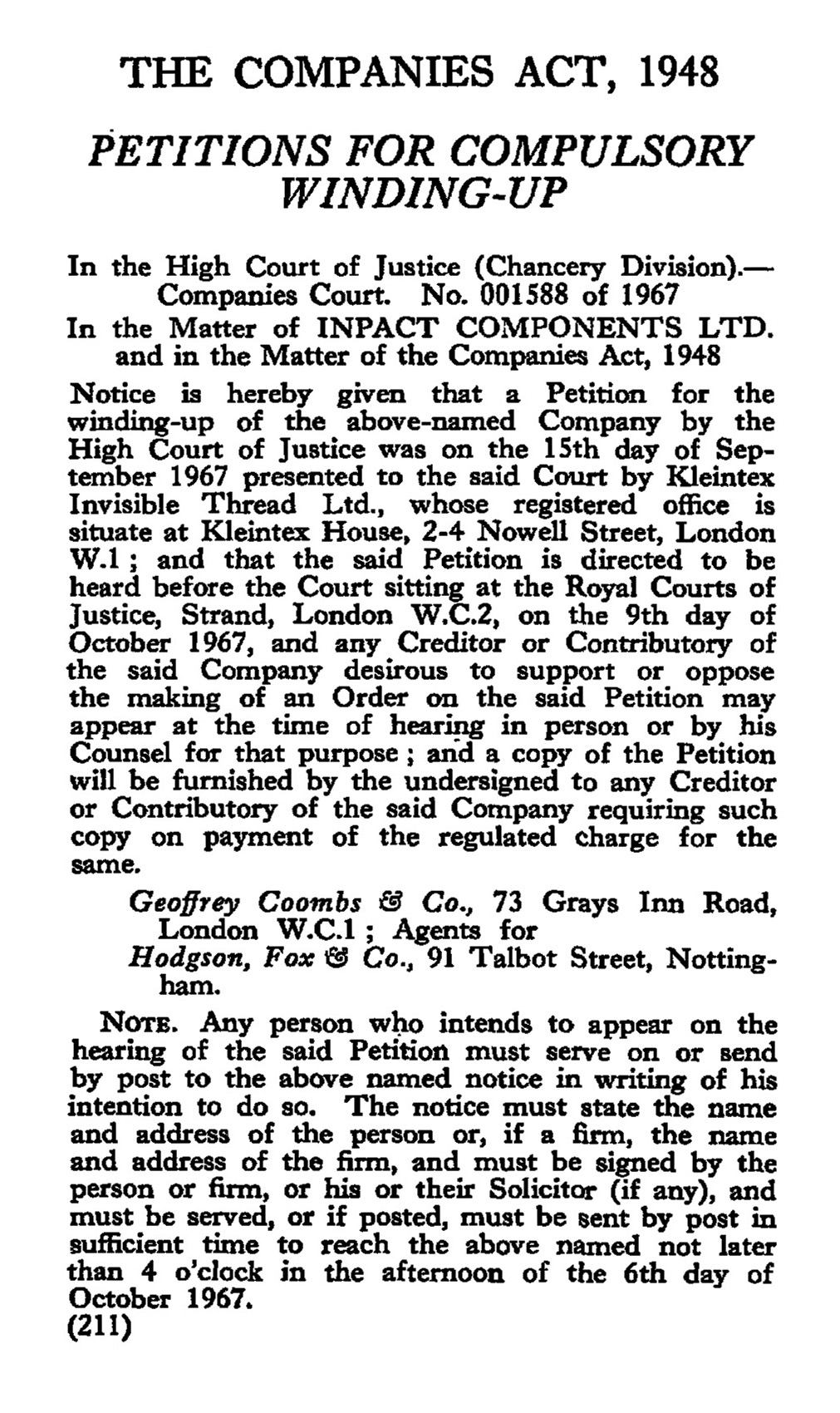
The only other reference I was able to find online at that time was the winding up of the company (no pun intended) on the 15th September 1967, notified via The London Gazette newspaper. Sadly, the trail ended there and as lockdown ended and we returned to work, other jobs to be attended to in the museum took priority.

Image ref: The company ceases to do business.
Image credit:
https://www.thegazette.co.uk/London/issue/44417/page/10540/data.pdf  


But then the second national lockdown happened. Finding myself working from home again, I revisited my earlier research and almost immediately found this available for sale on a popular online auction site, which I have been able to acquire for the museum:

Image ref: The natural colour invisible thread.
Image credit: Katherine Pell


Now we have the full address of the company and some wonderful contextual information to support the objects, as well as an example in the collection of both colours that had been originally manufactured. I have still been unable to identify a related patent or find out anything more about the company, the owner or the thread but I will be asking Pam to keep an eye out when she next delves into the MoDiP Reference Library.

If anyone reading this blog has any information to add to the story, please do get in touch.

Katherine Pell
Collections Officer


References

https://rcbookcase.com/data/thumbnails/6/06AeroModeller_June_1966.jpg

https://www.newspapers.com/search/#query=kleintex&t=5077

https://www.thegazette.co.uk/London/issue/44417/page/10540/data.pdf

McHard, J.D. 1966. Scale commentary. Aeromodeller, (online) (Vol. 31, No. 365), p.338. Available at: https://rcbookcase.com/data/media/6/06AeroModeller_June_1966.pdf (Accessed June 2020).

Scott, E. 2013. I could have been a contender: the memoirs of a black sheep(online) Bedfordshire: Andrews UK Limited. Available at: https://books.google.co.uk/books?id=6Ha6BAAAQBAJ&pg=PT171&lpg=PT171&dq=kleintex+invisible+thread&source=bl&ots=MYWbZh0mIG&sig=ACfU3U0WYZYH--OgEYOMij3d09Hr_1regg&hl=en&sa=X&ved=2ahUKEwi8v9z8kuPpAhXVURUIHWD7BzkQ6AEwAXoECAoQAQ#v=onepage&q=kleintex%20invisible%20thread&f=false (Accessed June 2020).

Wednesday, 3 February 2021

Pago Pago vase, Enzo Mari, 1969

Just before Christmas 2020, MoDiP acquired a beautiful Pago Pago vase, designed by Enzo Mari in 1969 for Italian manufacturer, Danese Milano. Mari (b.1932 – d.2020) was a renowned design theorist who both practised and taught throughout an illustrious career that resulted in the creation of over 1500 objects.


Made of ABS (acrylonitrile butadiene styrene), the vase was designed with flexibility in mind, being reversible. A single bloom can de displayed in the narrow opening but turn the vase over to place a bouquet into the wider mouth. The double vase shares an interior wall to enable a two-part mould in manufacture, with a double bevel included within the design to conceal possible moulding shrinkages. 


Image ref: The double bevel
Image credit:
https://pps-vintagedesign.ch/products/various/vase-pag-pago-enzo-mari

Even evidence of the injection moulding process has been made into a feature – the gate/sprue mark has been positioned in the centre of the narrow end of the inner cone: Mari referred to this as a ‘slug’.


Image ref: The injection gate mark
Image credit:
https://pps-vintagedesign.ch/products/various/vase-pag-pago-enzo-mari


Essentially, the vase is made up of two truncated cones, one smaller one upturned within the other, with half of the outer side cut away and new supporting radial walls connecting both structures. The base has also been opened to enable access to the internal frustoconical body. Confused? The drawing in the patent (below) should help to make things clearer.


Image ref: The patented design
Image credit:
https://patents.google.com/patent/US3729114


Mari spent a significant amount of time researching different flower types and sizes in order to determine both the functional requirements of the vase as well as its colour, to show off the blooms to best effect (it was made available in white, yellow, orange, green and violet – MoDiP’s example). He aimed to create something that was versatile, to remove the need to purchase a variety of different shaped containers, but that was also elegant and affordable.

Alessi re-issued the Pago Pago in 1997, recognisable by the company imprint on the bottom.


Often described as one of his most notable works, the complex structure of the plastics vase aptly fulfils Mari’s philosophy of designing both aesthetically and functionally, whilst doing justice to the material. He sadly passed away in October 2020, aged 88, due to complications related to Covid-19. 

Katherine Pell
Collections Officer


Wednesday, 27 January 2021

Provocative plastics: their value in design and material culture

Back in 2015, the Arts University Bournemouth held an international conference, Provocative plastics: design in plastics from the practical to the philosophical, attended by scholars, art and design practitioners, and members of the plastics industry from five countries. We are pleased to announce that the book of the conference has now been published: https://www.palgrave.com/gb/book/9783030558819.


Its scope is more focused than the conference but on the area that elicited the most interest, plastic’s value. It consists of two sections. The first explores the multivalent nature of plastics’ materiality and their impact on creativity through the professional practice of artists, designers and manufacturers as a medium for making. The second explores how they are valued in societal use, people’s attitudes to plastics and the different values that can be applied to them.

The book is unusual in the range of its tone arising from the variety of experience of its authors. Some have hands on knowledge of working with plastics. As a result, their perceptions stem from anecdotal experience that, nonetheless, because of their practical knowledge of working with plastics as a means of livelihood, contribute meaningful testimony to the wider picture of plastics’ value. Others have researched their subject from specific theoretical standpoints and provide more traditional academic arguments. Some themes are common across chapters. Indeed there is a synergy across the texts in the two sections but from different perspectives. It is the interdisciplinary approach that sets this compendium apart. It brings together a variety of voices to unpick values attached across time to this paradoxical materials group, as their unique properties lead them to play an ever more essential part in our lives whilst simultaneously their ubiquity creates an ever-greater problem that we must solve.

Professor Sir Christopher Frayling, Cultural Historian and former Rector of the Royal College of Art and Chair of Arts Council England, says: ‘Plastics have had a very bad press - from just about every point of view: environmental, social, cultural, aesthetic, the lot. This book adopts a series of fresh perspectives on this much-maligned material. It explores, on the whole dispassionately, the use of plastics in fine art, industrial and product design, fashion, popular culture, in craftsmanship and in industry. And it asks the question ‘is it possible to have sustainable plastics?’ Provocative? Yes - and also both timely and important. For too long, the debate about this product of chemistry and manufacturing has been characterised by rhetoric and knee-jerks. It’s time to reflect.’

Susan Lambert
Chief Curator

Wednesday, 20 January 2021

Fascinating finds from MoDiP's Reference Library

Whilst undertaking research in the MoDiP library, before lockdown #3, I found a mountain of ‘useful’ information, but not that little bit of information I was looking for. Still, it is a fascinating way to spend a few hours and quite a bit of what I came across relates to objects in our collections. 


One of those objects is a No. 2 Hawkette camera with a Bakelite case (refer image above). It was made for Kodak circa 1927, but we didn’t know who actually made the outer case, until today. We now know that Solidite and Synthetic Mouldings Limited (refer image below) manufactured the mouldings for Kodak, a piece of information that, for many objects, is all too often difficult to establish with the passage of time. Now we will be able to update the information on our website.  


Of course, such endeavours are not new to the research that the MoDiP team undertakes on a regular basis. In 2013 MoDiP launched the ‘10 Most Wanted’ project, a Digital R & D Fund for the Arts project undertaken by MoDiP in partnership with the University of Brighton and Adaptive Technologies. It sought to crowd source information relating to selected objects in the museum’s collections that had been difficult to find. With the help of social-media, a wealth of invaluable information was unearthed and recorded for posterity and it provided a template for other museums to gather difficult to find information relating to their collections.

I have been trawling through bound volumes of British Plastics & Moulded Products Trader from the 1930s and, as with most old periodicals, the advertisements are as interesting as the articles. Those adverts tell a story. Who was producing what and for whom and who were they trying to sell it to at any particular time. 


These trade publications are also full of adverts for long forgotten plastics materials which would have been familiar names to consumers and manufacturers of the time, Sicalite, Stanite and Nestorite and Indurite, for example, but not Birmite that I was searching for. 


Since starting this blog I have encountered another ‘ite’ for which I need to find information, namely Jaxonite, a type of phenolic resin. And so, when I can get back into the museum, the search will continue and I will try not to get too distracted by the ads., but they are fascinating…

Pam Langdown
Documentation Officer


Wednesday, 13 January 2021

Horn combs

The museum recently (pre-covid) took receipt of a selection of 139 horn combs, acquired by the Worshipful Company of Horners to be accessioned into their collection, which has been cared for by MoDiP since 2010.

Horn has been used since prehistoric times as a cheap, readily available, easily worked material from which essential tools, as well as decorative items, were made. It is considered to be one of nature's plastics because of the way in which it can be moulded with the application of heat and/or pressure. The Horners’ collection provides a comprehensive insight into the use of this material up to the development of the early synthetic plastics which replaced it.

MoDiP’s Documentation Officer first completed the object entry process: listing each comb within the museum’s Accession register, ascribing a unique number and then labelling the objects and finally, producing a searchable catalogue record within MoDiP’s collections database. Once all of the data had been captured, the combs were handed over to me for storage.

After an initial assessment of the size and variation of the objects as well as the shelving space that had been set aside, I ordered some ‘Really Useful’ boxes, matching those already being used to house this particular material. Being made of strong and inert polypropylene, these boxes also stack easily and are transparent so that the contents can be viewed easily. 

Image ref: Preparing the storage boxes in the museum.
Image credit: Katherine Pell


Each box had to be lined with plastazote, a chemically stable, polyethylene foam cushioning material. We buy this in very large sheets and I was able to make use of the museum space, during quiet periods, to spread out all of the equipment I needed to cut it to size (see image above). I typically use a ruler, scalpel and cutting mat for this but am thinking about investing in a thermocutter hot knife tool – it would certainly have made this job a lot easier!

Next, the combs were sorted so that similar types could be stored together. This is advantageous for minimising future handling; if a researcher wanted to look at all of the mourning combs for example, it is much easier to retrieve one box containing them all than to search for and then remove ten different objects from ten different boxes. It is also beneficial to keep similar materials together; several combs contain silver which require regular condition checking - far simpler to achieve if they are all located in the same box and maintaining specific environmental micro-climates becomes much more straightforward too.


Image ref: The combs all sorted into boxes.
Image credit: Katherine Pell


Finally, each box was then divided up into sections with further plastazote being used to separate, support and cushion each comb (see image below). 


Image ref: A box of hair pins, sorted (left) and then stored (right).
Image credit: Katherine Pell


The boxes were then numbered, positioned on a shelf on the roller racking in the store and each comb’s catalogue record updated with a location reference so that they can be identified. The next job is photography, which we hope to begin soon, and then the records will be made available to search online through MoDiP’s website.


Image ref: Boxes numbered and located on a shelf in the store.
Image credit: Katherine Pell


There are some really lovely examples in this collection but my favourites are the painted combs, particularly the bird and the butterfly (see image below). Made in China in the mid twentieth century, they are both translucent horn, shaped specifically to incorporate the beautiful hand painted design.

Image ref: The painted combs.
Image credit: Katherine Pell


All of these objects, along with the rest of the Worshipful Company of Horners’ collection, can be viewed in the museum by request once we are able to re-open.

Katherine Pell
Collections Officer

Tuesday, 5 January 2021

My plastics at home: part 3

Another year, another lockdown so obviously time for another My plastics at home blog!

I was thinking about the last blog we had written in this series where each member of the museum team had chosen a plastics object from home that was important to them in some way. It suddenly occurred to me that there is another object that I use on an almost daily basis that has proven invaluable over the years, but being so familiar I had not recognised its significance until today. It is my trusty travel mug – see image below.

My Aladdin travel mug

My Aladdin travel mug
(image credit: Katherine Pell)


It was purchased for a few pounds at a local discount shop, about sixteen years ago when my first child was born. I heeded the advice given to me by my maternal grandmother that you should get out of the house at least once every day with young children, regardless of the weather. For me, as much as for my daughters, each morning I would pack up the pushchair for an adventure. As well as the nappies, wipes, milk and snacks (once they had started weaning), I always made sure I had my coffee ready to go in this amazing, totally leak-proof cup. Being so impressed by it, I went on to purchase an additional one in blue for my husband.


Mine and his
(image credit: Katherine Pell)

Made of injection moulded polypropylene, the insulated double wall construction is designed with silicone banding running all the way around the exterior for grip, alleviating the need for a handle. The lid has a repeated pattern of two indented circles to assist with screwing and unscrewing and contains two (yes, two) rubber seals that ensure this mug is 100% reliable.


Unwashed mug and lid!

(image credit: Katherine Pell)

Although they are a bit battered now, these mugs are still going strong and have accompanied us on our many travels around the country, as well as the daily (sometimes twice daily) dog walk, the school run and the (pre-covid lockdown) commute to work. By reusing them we do not have to buy a drink whilst out and about; saving us money and reducing our impact on the environment. They have never failed us and I have yet to find their equal despite acquiring many alternatives that, despite claims to the contrary, all end up leaking. Usually in my bag.

Perhaps best of all, my fabulous plastics travel mug reminds me of a stylised stormtrooper! Or is that just me?

Katherine Pell
Collections Officer