Wednesday, 24 April 2019

‘Bayko. The Original Plastic Building Sets’


The objects in the collection of the Plastics Historical Society are cared for by MoDiP and from time to time additions to the collection come our way.  As the museum’s Documentation Officer, it is my job to catalogue these items so that they can be made available for all to see via MoDiP’s website.  One of the more recent arrivals was an intriguing wooden box containing an amount of Bayko.

Image credit: MoDiP
For those unfamiliar with Bayko, it was a building construction system consisting primarily intended for model buildings but basic, entry level sets were introduced to appeal to children.

Image credit: MoDiP

It comprised bases, bricks, windows and doors etc., with metal rods, inserted into the base to hold it all together.
 

Image credit: MoDiP


Image credit: MoDiP

Image credit: MoDiP

Image credit: MoDiP
The sets were available from 1934 to 1967.  Bayko was invented by Charles Plimpton in 1933. The material from which it was made came from Bakelite Limited and the sets were initially called “Bayko Lite Construction Sets’.
By 1938 the Bayko name had been adopted and new sets with specialist components were offered. Production was interrupted by World War II when the company switched to production to support the war effort.  It resumed making Bayko in 1946, offering a reduced range of sets.  
Charles Plimpton died in 1948 and his wife Audrey Plimpton took over the running of the company. Audrey Plimpton retired in 1959 at which point the company was sold to Meccano Ltd, whose magazines Bayko had been advertising in for 25 years. Meccano Ltd redesigned the sets, added to the number of sets available and began to make the parts from polystyrene to cut costs.  Subsequent years saw other changes such as the introduction of flanged bricks and limiting the colours available, under the ownership of Tri-ang, who bought out Meccano Ltd, but eventually demand for the sets fell. By 1967 all manufacturing of sets and spare parts ceased.
MoDiP has its own example of Bayko which has been on display a number of times, but if you would like the opportunity to examine either of the two sets in our care please make an appointment with a member of the MoDiP team to do so.

Pam Langdown, Documentation Officer.

Wednesday, 17 April 2019

Egg cups

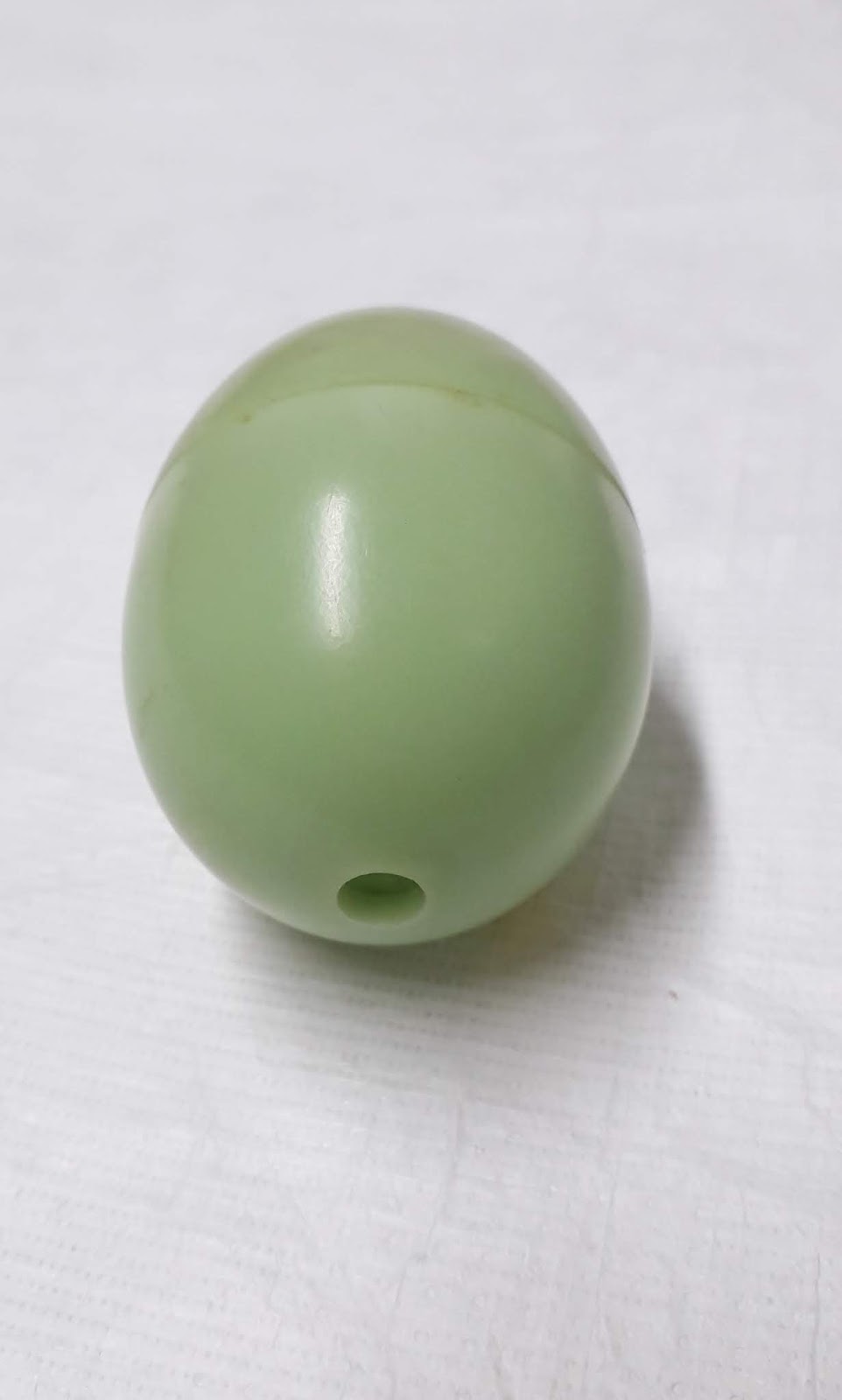
With Easter fast approaching, I was particularly pleased to find this little gem amongst objects recently acquired as part of the collection of the Plastics Historical Society. 


Small and perfectly formed, this small green egg contains two simple bases which push into the upturned half egg shells, to form a pair of egg cups.  Made from green urea formaldehyde we think it dates from the 1930s, but it has no makers marks to help us with identification. 


Egg cups can perhaps be seen as a miniature manifestation of the prevailing stylistic influences of the time in which they were made, with the colour and materials used as extra clues to their date of making. So many of them are unmarked and the ones we have here in the collections of MoDiP and the Plastics Historical Society include many anonymous examples.  There are, however, examples from well-known makers such as Bodum, Tupperware and zak!, and for those particularly interested in older plastics materials, Ranton, Mendel Brothers, De La Rue and NB Products.   We even have an example of the Yowk pot, packaging designed to hold a healthy on-the-go snack of a pre-boiled egg, breadsticks and seasoning.  The packaging is designed in such a way that when turned upside down, the top becomes an egg cup.  This idea was short lived because of inconsistencies in cooking the eggs. 

If you would like to come in and see any of these objects, or anything else from the collection, please contact a member of the MoDiP team.

Pam Langdown, Museum Documentation Officer.

Wednesday, 10 April 2019

Oxfam Jerry Bucket

MoDiP has recently acquired this Oxfam Jerry Bucket, an improved version of the original 1998 design. Always intended as a safe water container as opposed to a multipurpose bucket, this 14L capacity, heavy duty, UV resistant, plastic water bucket has a tight-fitting lid, robust flat handle and clip-on cap.


Agency workers started to observe people using the bucket without the lid - an integral feature for the transport and storage of safe drinking water. The previous cap had been so small, that filling the bucket from a tap, pump or spring had been too difficult, resulting in the lid being removed and inevitably never replaced. The buckets then began to be used for carrying food and washing clothes. Consequently, Oxfam redesigned the lid to include a rim-lock system, so once snapped onto the bucket it is very difficult to remove. The cap opening was also made bigger to not only ease filling but allow easy access for cleaning.

Made from polyethylene, the bucket offers a safe solution for water storage, protecting from pollution and further contamination. It has become established worldwide as a standard safe water container, and is used by many other relief agencies including the UN and the Red Cross.

We would like to thank Oxfam for donating this bucket to the MoDiP collections - and you will soon be able to see it on display in the 'About Plastics' case in the museum.


Katherine Pell, Museum Collections Officer.

Wednesday, 3 April 2019

Nylon: ‘the durable and indestructible material of the people’


In 1928 Wallace H. Carothers, an organic chemistry lecturer at Harvard University, joined DuPont, a chemical manufacturing company, to lead a research team identifying potential commercial uses for different polymers. After several years of experimentation, the chemists produced a material that could be drawn out into long, thin strands which were extremely strong and durable. It was patented in 1937 as nylon 6,6.


Pulling a heated rod out of a mixture of carbon, alcohol, coal tar and water


Nylon is not just one material but instead refers to a family of very similar polymers known as polyamides. The original and most commonly used of this family was nylon 6,6 but other chemical manufacturers wanted to reproduce it without breaching the patent on its production. Many different versions have since been created which in turn all have different properties eg. nylon 6, nylon 6,12, nylon 4,6 etc.

The first commercial product to use this synthetic material was Dr West’s Miracle Tuft, a toothbrush with nylon bristles released in February 1938. DuPont soon realised nylon’s characteristics were ideal for the hosiery market and built a factory in Delaware the following year that ran for 24 hours/day, producing enough yarn in its first year of operation for 64 million pairs of stockings. Introduced to American consumers on 15th May 1940, 800,000 pairs were sold on that first day.

At a cost of $1.15 per pair, they looked like the more expensive silk stockings but were cheaper, more robust and easier to care for. But no sooner had they appeared on the shelves of department stores across the United States, they disappeared as the country entered the Second World War. Supplies became severely restricted as output was channelled into military use with nylon producing such vital equipment as parachutes, tents, mosquito netting and hammocks. As soon as the war ended DuPont resumed stocking production with demand quickly exceeding supply: newspapers reported ‘nylon riots’ taking place as thousands of US women mobbed stores with limited stock.


AIBDC : 008191Aristoc Full Fashioned Nylons, 1947 – 1952. Picture credit: MoDiP


The first British made ‘nylons’ appeared in 1947 such as the pair featured in the photograph above from MoDiP’s collections and currently on display in the Plastics & the home front exhibition. This exhibition is in support of Dazzle & The Art of Defence.


Since then nylon has become ubiquitous. Continued innovation and development has led to the creation of a wide range of nylon-blended fabrics that produce inexpensive, colourful, wash-and-wear clothing and the material can also be found in products ranging from kitchen utensils to medical implants. 

MoDiP has over 280 objects made from polyamide (nylon) including some fantastic 3D printed pieces that can be viewed or borrowed for inspiration.

A few interesting facts about nylon: 

  • In 1938 the Washington News printed an article claiming that nylon could be made using cadaverine, a substance formed during the putrefaction of dead bodies.
  • It was claimed that nylon was the material used to make the tornado that whisked Dorothy to the Emerald City in the 1939 film The Wizard of Oz.
  • An alternative name proposed for nylon was ‘klis’ which is silk spelt backwards.
  • Wallace H. Carothers was also involved in the creation of neoprene, a synthetic rubber commonly used in wetsuits, and had almost 50 other patents to his name by 1937. Unfortunately he committed suicide that same year.
  • DuPont developed many other successful polymers including Teflon, Mylar, Kevlar and Lycra.
  • In 1969, Neil Armstrong planted a nylon flag on the moon. 

Katherine Pell, Museum Collections Officer.


Wednesday, 27 March 2019

Revolution: environmentally conscious design in plastics

We have recently opened our latest exhibition, Revolution: environmentally conscious design in plastics. It is an exhibition that has been inspired by the devastating images of plastics waste in oceans and streets, and is our way of highlighting the value of a material group that is so easily discarded.

We start by thinking about ‘single-use’ becoming Collins Dictionary’s word of the year in 2018 and how they define the word as being strongly associated with plastics. MoDiP wants to acknowledge that objects made of plastics that are in the wrong place, doing the wrong thing, and being disposed of without care, are indeed problematic to the environment. This has meant that plastics have become synonymous with the term ‘single-use’ and with environmental devastation; as well as the depletion of fossil fuel stocks, despite plastics being responsible for only 4% of crude oil usage.

Revolution aims to redress the balance by exploring environmentally conscious design in plastics. It looks at the use of recycled and upcycled materials, alternative sources of raw material feedstocks, and some of the ways in which plastics objects can actually help to prevent environmental damage.

Some of the highlights in the exhibition are the upcycled and recycled products made from a variety of interesting starting points. For example, a dinghy which has been made into a bag, milk bottles that have been made into building blocks, chewing gum that has become a collection bin, and toys that have been turned into a storage box. 


Top row l-r: Inflatable Amnesty bag, Wyatt and Jack, 2018. AIBDC : 008202. Blocks, Green Toys, 2011. AIBDC : 006138. Bottom row l-r: Gumdrop bin, Gumdrop, 2016. AIBDC : 007949. Kiwi, ecoBirdy, 2018. AIBDC : 008170. Image credit: MoDiP.


Increasingly, when plastics are mentioned in the media, it is to report on the environmental damage that they cause. However, plastics can be used to play important environmentally supportive roles. One case in the exhibition, Plastics for good, looks at just a few of the examples of plastics products helping to preserve the environment. The most poignant object being the fence boom, a piece of plastic designed to go in waterways to prevent further contamination. 


Fence boom, Darcy Spillcare, 2019. AIBDC : 008199. Image credit: Darcy Spillcare 

In the Revolution exhibition, we are also exploring the difficult concept of ‘bioplastics’ and what is meant by the term. Bioplastics is confusingly used to mean either a material that is produced from a recently living organism known as biomass, as opposed to those that lived many millions of years ago and consequently creating fossil fuels, as well as materials that will biodegrade. However, not all plastics made from biomass are biodegradable, and not all fossil fuel based plastics are not biodegradable.

It is generally thought that using materials that are made from biomass and/or are biodegradable is the answer to the waste issue that the world is experiencing at the moment. Yet, the bigger picture shows that these materials are not without their faults. Growing crops to make biomass for plastics diverts land from growing food for livestock and people; the compostable waste infrastructure is not in place to take biodegradable materials that need industrial settings to degrade properly; if these materials go in the recycling system they can undermine the resultant output; and finally if they end up in landfill they can produce methane, a greenhouse gas, as they breakdown. Creating products out of biomass and biodegradable material is one-step in the journey to reduce the impact on the environment, we just need refuse and waste infrastructures around the world to catch up.

Revolution runs from now until 6th September we hope you can come and see the real thing but if not you can view the whole exhibition on our website.

Louise Dennis, (Curator of MoDiP)

Wednesday, 20 March 2019

Student Creative - Animation team


Our Project aim: 3D print and construct a Zoetrope, see our last blog post for our initial plans (http://museumofdesigninplastics.blogspot.com/2019/01/student-creative-animation-team.html


fig. 1 - A Zoetrope

MoDiP – font of all plastic inspiration 

The collection at MoDiP has allowed us to see familiar objects in new ways. I particularly recall the feeling of seeing a milk carton in an entirely knew light, when I saw it in the ‘See Through’ exhibition at MoDiP. (https://www.modip.ac.uk/artefact/aibdc-007141)

We want to do the same for animation. Taking a familiar art form that most people see everyday in one form or another, and making you take another look – making you think again.

Utilising the phenomenal ability of plastics, to help us keep order to the chaos of the world around us, is exemplified in the Tupperware display MoDiP is 
currently showing. (https://www.modip.ac.uk/artefact/aibdc-005464). Tupperware can keep all manner of things separate and keep important substances apart. 

Our response to this is to create a 3D plastic printed animation displaying the chaos of disorder, which only becomes clear motion once a flashing light and rotating table are added. For us animation is the chaos in which only 3D printed plastic and a rotating table can find order.

The Team – An evolution

Our initial team of ten has slimmed down as members of our 2nd year animation CG pathway have made decisions to leave CG work behind. However, 3rd years interested in the project have stepped in to join us to produce this project. As we currently stand the team is:

Producer: Jonny Strutt
Supervising Director: Merlin Voss
Animator: Sam Elphick
Assistant Modellers/Riggers/Animators: Calum Avery, Mitchell Shilling, Ciara Davis
Supervising Lecturer: Ian House

Where the project is now:
 
fig. 2 - GIF of the line test done for the animation

The zoetrope has moved along the pipeline of production well. The conventional parts of the 3D animation process (line tests, modelling, rigging, and key-posing) have been relatively smooth.

fig. 3 - Rigging and modelling progress shot

However, one key element of the rigging process called ‘Weight Painting’ has been a cause of some grief. Without it, the skeleton constructed during rigging would move independently of the model, leading to no animation. Not much help. When it is done badly, or as in this case, it is the first time using the tool, the model can not only animate badly, but break apart entirely. The loyal cart horse that is the phenomenally complex computer code behind 3D animation can easily buck and takes quite some calming down if it does. 

fig. 4 - pictures of broken weights

However, once a few pose tests were done, and the tool was grasped, the rigging was complete and the animation could progress smoothly to its eventual conclusion: a shot of a character viewed from one side only, as dictated by the filmmakers.

fig. 5.1 - Picture of fixed weights
fig. 5.2 -  Animation GIF

Bringing the animation into a 3-dimensional space will allow an audience to see and enjoy the subtleties of the animation from any angle they can crane their neck to see. This prospect excited me greatly, as when animating in CG I have often found ‘animating to the camera’ has caused the work to look good from one angle alone, so when moving around the animation in virtual 3D space, it suddenly looks much less effective. (On more than one occasion legs have been stuck at bizarre angles simply by virtue of being off screen and therefore irrelevant to the film.) 

Displaying animation in such a way as to be able to look at the whole body, from any side, has forced me to improve my animation. The overall movement must read from any angle, the arcs need to work in a 3D space, no longer just a 2D plane, and the action has to read clearly from as many angles as possible. It is no longer animating on a virtual set, it is animating on a virtual theatre stage with a mobile audience.

fig.6 - Models placed on the virtual zoetrope

fig. 7 - Zoetrope GIF test

From here more characters will be added around the one I have done, by the other members of the team following the same process as myself.

The next stage – Virtual to Reality

A good chunk of the usual process is complete. Now the transition begins - breaking the veil of Maya, pulling the curtain back between the illusion of the virtual world and the tangibility of reality is all that’s left to do. Simple.

The plan is as follows:

1. 3D print the ‘frames’ of animation as individual models using the wonder material that is plastic.

2. Clean the models of any unforeseen elements of the printing process.

3. Laser cut a disk for the models to slot into perfect alignment for the animation. [see fig. 8 below of the plan for cutting.

4. Put the parts together on a turntable using nuts and bolts.

5. Add the motor and flashing lights.

6. Watch the models come to life in an exhibition space.

fig. 8 - template for model placement

Each stage may pose new problems as this is the key challenge of the project – getting an animated performance sculpted in three dimensions. This challenge we will take one step at a time.

Taking on a challenge is what animating is all about, we wouldn’t do it if it was easy.

Written by Jonny Strutt

Wednesday, 13 March 2019

Student Creative - Adalheidur Agusta Jonsdottir

When making a pattern it can be interesting to use shapes from real life. The bowl that I used as my inspiration had a lovely bubbly shape to it. 

At first, for my Final Major Project, I was going to use Lectra - a pattern cutting software - to make the skirt. Then I started playing around with another pattern cutting software called Clo3d. I realised that the 3D virtual avatar in Clo3D, is much more realistic than the Lectra avatar. 


Image credit: Adalheidur Agusta Jonsdottir


Image credit: Adalheidur Agusta Jonsdottir

Image credit: Adalheidur Agusta Jonsdottir

Image credit: Adalheidur Agusta Jonsdottir


Out came the shape I was looking for, and I am happy with how it moves when I make the Avatar move. 


Image credit: Adalheidur Agusta Jonsdottir

Image credit: Adalheidur Agusta Jonsdottir

Image credit: Adalheidur Agusta Jonsdottir

Image credit: Adalheidur Agusta Jonsdottir


Since this is a virtual reality project, I want to make not only the skirt, but a top to go with it. For my final outcome I am going to have an outfit on virtual reality, that represents the inspiration I got from the MoDip museum. 

Adalheidur Agusta Jonsdottir - Student Creative