Wednesday, 21 October 2020

#MoDiPDiversity

Inspired by Black History Month, we decided to review our collection with regards to diversity.  Many museums have done similar activities, in light of the Black Lives Matter movement, highlighting objects that have been looted from indigenous peoples or that celebrate the work and achievement of slave owners or those that benefited from the slave trade.

I am happy to say that the MoDiP collection does not suffer from containing objects that are so controversial.  However, our review showed us that the objects in our collection do not represent many (if any) black, Asian or minority ethnic designers.

MoDiP collects objects, first and foremost, because of what they are, how they function, and what they look like.  We have a collection development policy which can be found on our website,  but in essence all objects in the MoDiP collection relate in some way to our plastics focus.  In addition, they conform to one of three other criteria:

  • To be an interesting design
  • To provide insight into the society of which they are a part, or
  • To be documented in such a way that they add to plastics' history

The collection comprises objects that describe a variety of uses and activities.  These take into account the clothes we wear, the games we play, and the environments in which we live. 

Designers and manufacturers emerge from the collection, that is, if they are named.  Many of the objects in the collection are anonymous, we may not know who the manufacturer or the designer is, or the designer might be part of a design team who only get recorded under the manufacturer’s name.

Now that we, as a museum, are in this position we are seeking out these under represented designer and we would like to ask for your help.  We have a number of questions for you, our audience:

Firstly, to help us add to, and improve, our collection we would like to know who are the BAME designers who have worked / are working with plastics who should be represented in our collection?  At the same time, we would like to open up the debate about diversity in the design industry, particularly product design: 

  • Why are there few renowned BAME product designers?
  • Are they there but not being named?
  • Is it the nature of the design industry that it does not have a diverse workforce? 
  • Are undergraduate design courses lacking in diverse students?
  • What can be done about it?

Join in the discussions on our social media by using and following #MoDiPDiversity

Louise Dennis, Curator of MoDiP

Wednesday, 14 October 2020

Horn Chairs

I’m always amazed at the number of chairs MoDiP has in the collection. We are lucky enough to have some iconic designs including two of my favourites: the Panton chair, the first single-piece plastic chair to go into mass production in 1967; and the E Series chair, which instantly brings back memories of being at school. The Hembury chair is the only one in the collection to include any animal parts, through wool being used as the reinforcing ingredient within a resin base. Our guest blogger this week has written about horn chairs, something we don’t currently have represented within the Worshipful Company of Horners collection.

Katherine Pell, Collections Officer 


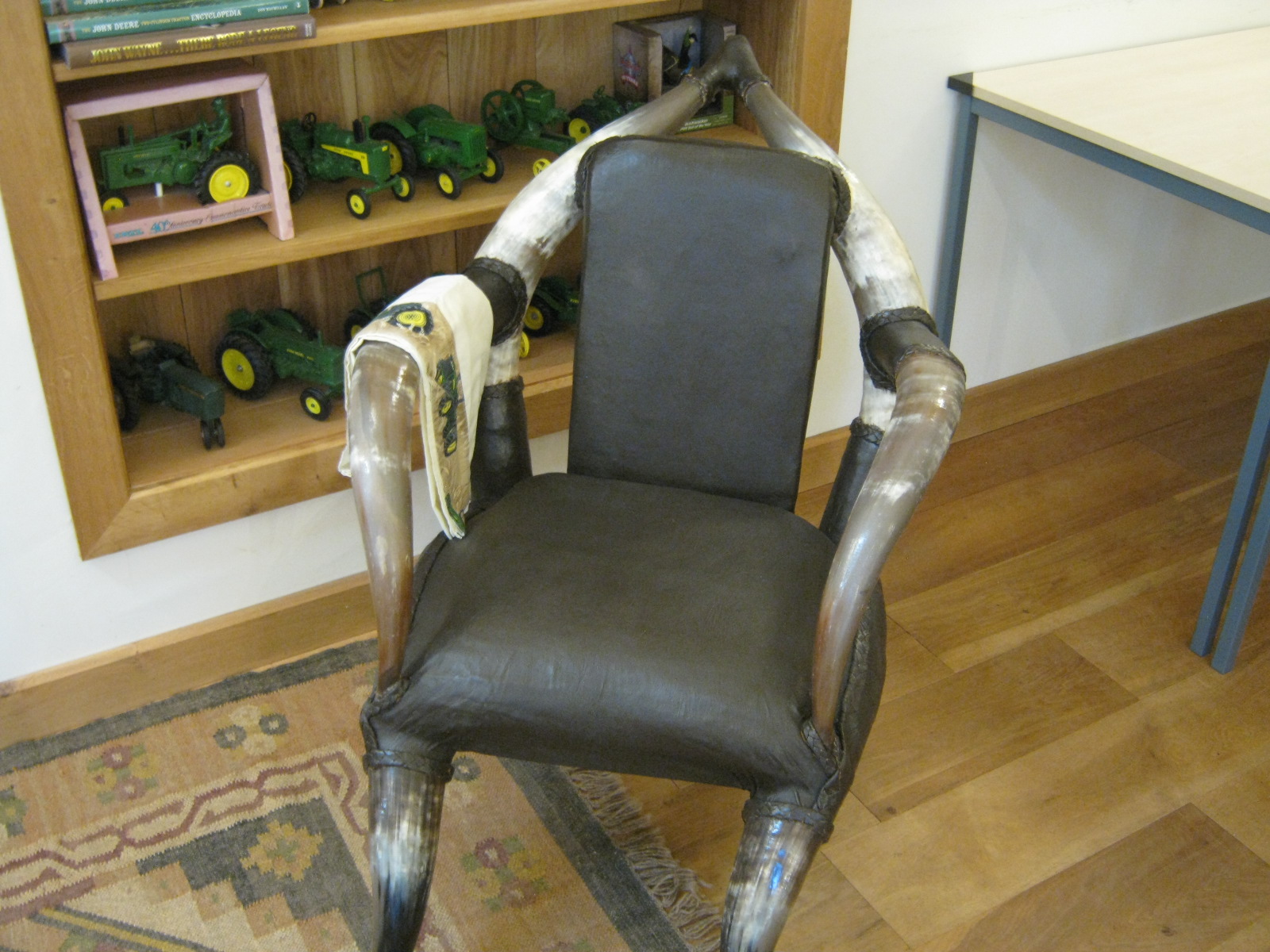
Surely the largest hornware artefacts you will see are the horn chairs? They are not only dependent on a ready supply of long horns, but on a ready supply of pairs of long horns.  Most of these items, unsurprisingly, come from Texas and the Western States.

Quite by accident I found a small collection of these unusual horn craft artefacts, seldom to be found outside the US, whilst visiting Parc Grace Dieu farm near Monmouth. My intention was to photograph their White Park cattle and I took along my postcard collection for reference. Anna, who met me, was very interested by these pictures and immediately latched onto one depicting a chair made from cow’s horns, taken in the Morse Museum, Warren, New Hampshire.

Image ref: Postcard of a horn chair from the Morse Museum
Image credit: Rebecca Davies


As it turned out, they have a few of these chairs at Parc Grace Dieu, and Anna was delighted to show me them. Their main chair came from Stockyard City, Oklahoma.

Image ref: Horn chair
Image credit: Rebecca Davies


This smaller chair was made by Abbey Horn

Image ref: Abbey Horn chair
Image credit: Rebecca Davies


Notice the back of this chair; it is designed so that pairs are not needed.

Image ref: Abbey Horn chair back
Image credit: Rebecca Davies

And they have a pair of chairs from Africa, possibly East Africa, where the Ankole cattle come from.

Image ref: African horn chair
Image credit: Rebecca Davies


All in all, a very interesting collection. I think I am going to save up and find myself a Horn chair of my very own. These artefacts are not actually that rare, you can find examples through online auction sites, but they are not cheap either.

Rebecca Davies


Abbey Horn - https://www.abbeyhorn.co.uk/

Alan Rogers Texas Longhorn Museum - http://www.longhornmuseum.com/index.htm

Parc Grace Dieu Farm - https://www.parcgracedieufarm.co.uk/

Wednesday, 7 October 2020

Another great collaboration!

Following on from the last Facebook exhibition we co-curated with TheGallery, our latest collaboration - ‘A Fresher’s Kitchen in Plastics’ https://www.facebook.com/TheGalleryAUB   – is yet another online exhibition, created to use MoDiP’s collections to inspire AUB Freshers to eat healthily and also feel a little more at home in their new student digs. 

Led by William Hernandez Abreu, Gallery Technician, this project has warmth, a designer’s eye and the well-being of Freshers students at its heart. 


William Hernandez Abreu and Julia Pulman


Together, we worked up the idea of showing new students that their health and well-being are of utmost importance through the selection of bright, uplifting and student-friendly kitchen objects, that could easily be included in a Fresher’s ‘Home Starter Kitchen Kit’ to help making meals a pleasure, with great health benefits both for body and soul. 


The objects selected, demonstrate how plastics are crucial in the design of kitchenware for example the ‘Chop2Pot chopping board’: a lightweight, easily cleaned and most importantly folding chopping board incorporating the innovative ‘living hinge’.


Chop2Pot chopping board


Another object that could only do its job by being made of plastics is the Tupperware ‘Small Wondelier bowl’: lightweight and strong but also translucent - for ease of seeing what’s inside - and incorporating the infamous, resealable (burpable) lid.


Small Wondelier bowl

And all plastics kitchenware can of course be made in any colour of the rainbow, and as bright as you like, as the very building blocks or ingredients (pardon the pun!) of plastics, can take on their desired colour completely ie if you chopped the ‘Chop2Pot chopping board’ in half, it would be bright yellow through and through – how sunny is that for a Fresher’s kitchen?


Julia Pulman, Digital Communications Officer, MoDiP.

Wednesday, 30 September 2020

Petit Pli – a plastics contribution to slow fashion

When we think about plastics, it is easy to forget that this material family includes a large and ever-growing number of synthetic fabrics. Developed from the second half of the 19th century, familiar examples include polyester (introduced in 1941) with easy-care properties and Lycra® (invented in 1958) with in-built elasticity. Continuous improvement and innovation has led to engineered technical textiles with specific functional properties such as Nomex® (fire-resistance) and Kevlar® (strength).

Increasingly, we are seeing clothing made of recycled plastics commonly using polyethylene terephthalate (PET) bottles and recovered ocean plastics. These sit well with the concept of slow fashion, an approach that has been gaining increasing momentum over the past decade; a reaction against cheap, mass produced clothing and consumerism in favour of more ethical and sustainable standards. 


Image ref: MoDiP’s latest acquisition – the Petit Pli ‘clothes that grow’.
Image credit: Katherine Pell


One of MoDiP’s latest acquisitions is a particularly good example of this. The Petit Pli ‘clothes that grow’ childrenswear range is made from recycled polyethylene terephthalate (PET) bottles, and because no other fibres are included, the clothing can itself be more easily recycled at end of life. However, what is really exciting and different about the design is that it uses origami principles of folding in order to stretch to fit a growing child (there’s a really good demonstration of that here).


Image ref: The trousers stretched to show the smallest and largest size possible.
Image credit: Katherine Pell

So, how does it work? Literature that accompanies the clothes explains all:


Image ref: Petit Petit Pli literature explaining how their technology works.
Image credit: Petit Pli


The company are promoting their top/bottom sets as being able to grow up to seven different sizes, adapting to fit a child from 9 months to 4 years old, thereby removing the need to purchase additional clothing. Their patent-pending technology retains a memory so that the pleats can be easily reset if they get caught up in use - a horizontal tug simply pulls everything back in to place. Petit Pli have plans to expand by introducing adult clothing (they’re already producing masks for covid) and hope to inspire others to reduce unnecessary waste. 

This object will be available for viewing/research shortly.


Katherine Pell.
Collections Officer.

Wednesday, 23 September 2020

Dart and the humble, disposable EPS cup


You might be wondering what’s so special about a humble disposable expanded polystyrene cup and why it warrants a place in the Museum of Design in Plastics collection. 

It is an object that most of us have encountered at some point in our lives, but we now might do less frequently as manufacturers and take-away retailers respond to consumer demands for more environmentally friendly materials. But the fact remains, that expanded polystyrene does a great job when we want to retain the heat of our food and drink. It is cheap to produce, lightweight, so transport costs are low, and contrary to popular opinion, it can be recycled when the infrastructure is there.  

This rather fragile little cup has its origins in mid-20th century USA when American company Dart developed their first disposable hot drinks cup.   Dart Manufacturing Company was established in 1937 in Mason, Michigan, USA, manufacturing products such as plastic key cases, steel tape measures and ID tags for the armed services. In the late 1950s they had begun to experiment with expanded polystyrene foam and they began production of the first 6oz insulated foam cup in 1960.


By 1962 they had expanded their range to include 8 and 12oz cups and an 8oz food container, and in 1963 they changed their name to Dart Container Corporation.  Throughout the 1960s they expanded production and their range, opening plants across the USA and in 1965 fulfilled their first order for 1 million cups, to one customer in 1 month. 

In its first half century, Dart grew to become a global corporation with a range of more than 600 products for the food services, retail and packaging industries and is the worlds largest producer of single-use foam cups and containers. 

With an awareness that the recycling of expanded polystyrene is not as commonplace as the recycling of other plastics, Dart opened its free public EPS recycling facility in the West Midlands, UK in 2011. The company has an active environmental policy with many initiatives to limit or eliminate the impact of their products.


So next time you find yourself drinking from an expanded polystyrene foam cup, take a moment to look on the bottom. Chances are it will carry the DART logo and with it, decades of history. 


Pam Langdown, Documentation Officer.

Wednesday, 16 September 2020

Synthetica: a toxic enchantment ONLINE

Synthetica is a chamber opera about plastics with libretto and music by Karen Wimhurst, created during her residency at MoDiP. Following my post of 22 July, I am pleased to share the good news that Arts Council England have agreed that, because of the shut down of theatres caused by Covid 19, we can use our grant, intended to further performance of the work, in a different way. The project team has already met, some in person and some online, to work out how to develop the opera levering value from the virtual platform. Who knows, it could even turn out to have greater impact and we will not lose sight of the importance of again providing live performances when that becomes possible.

Currently there are eleven sung chapters that tell the story of plastics from the early expectations of this essentially modern materials group to the current troubling reality. These existing chapters will be presented Zoom-like by the singer, Brittany Soriano, and the trumpeter, Elaine Close, with vinyl accompaniment, reflecting the new normal. The viewer will be able to experience whichever chapter they feel drawn to, selecting from a turntable of possibilities along these lines, although the design is still very much work in progress:

Synethetica A toxic enchantment

Each chapter will provide inspiration for learning resources, which will be accessed through six objects from the MoDiP collection that tie in with the lyrics.

For example these lines from the chapter ‘Utopian Dream’:

Nature’s larder will be left untouched

Grained ivory, turtle shell, amber, horn,

mother of pearl, coral and the lac beetle

ebony, mahogany and oak,

the whale swims in the blue ocean

the elephant runs free

the leatherback turtle saved

might be accompanied by items such as these:


Ivory coloured powder bowl

Each MoDiP object will be the trigger for a particular learning resource aimed at Key Stages 3 to 5 (ages 11-18) consisting of a cross curricular series of ideas and tasks.

The opera itself poses the question where are we going now? Given the lesson history shows us, what are the possibilities in the new world we enter? With this in mind the website will contain a new chapter in the opera as imagined by young people.

We propose holding online workshops. The trumpeter and the composer will demonstrate trumpet techniques and approaches to writing fanfares. The singer and composer will collaborate on composition workshops in which small snatches of libretto will be written and sung. Participants will then be invited to submit their fanfares and thoughts about the future of plastics directly to the website. In addition to creating a new chapter we will build a resource from their ideas looking to the future value of plastics while acknowledging the issues that make many uneasy about the material group’s prevalence.

Susan Lambert, Chief Curator, MoDiP.

Wednesday, 9 September 2020

Your five a day

Inspired by our current #anappleaday social media campaign for September, I thought why not show how our collections can encourage us to reach the ultimate healthy-eating goal, and go the whole hog (not a great expression for a vegetarian) with a blog post featuring your 'five a day' fruit and veg.

Jif Lemon bottle

My first offering is this infamous - and easily recognisable - Jif lemon-juice container made from blow-moulded polythene. The design has remained relatively unchanged since the 1950s, so it is a definite winner in my book. Rich in vitamin C, lemon juice can add that much needed zing of acidity that enhances the taste of a whole range of dishes. So, although we wouldn’t eat a whole lemon in one go like we might eat an apple, its juice is one of the most versatile and commonly used ingredients in our daily diet.

The Cooks Carrot

My second object is this whisk, which has a carrot-shaped handle made of orange silicone and balloon wires covered in green silicone which look a bit like carrot tops. If this doesn’t inspire you to whisk up a healthy carrot soup, or maybe the ingredients for a ‘healthy’ carrot cake, then nothing will.

Bananice moulds

My third choice is this set of banana shaped ice lolly moulds. Each one has been made in the shape of a banana with the holders resembling peeled back banana skins. What better way to enjoy this potassium rich fruit, than mixed with yoghurt (and maybe a few strawberries) and frozen for a fun-filled fruity treat.

Strawberry Flip Syrup bottle

And talking of strawberries, my fourth choice is this strawberry-shaped, blow moulded bottle, used to contain syrup for flavouring (healthy skimmed milk) milk shakes – though you will have to add a handful of fresh strawberries, to count it as one of your 'five a day'!

Sweetcorn butter dish

My fifth and final object to inspire your ‘five a day’ is this polystyrene, butter dish in the shape of a corn-on-the-cob. And if you love the buttery taste of corn, where better than to keep your butter than in here? With vitamins B and C, as well as magnesium and potassium, corn is a much-loved summer vegetable which is enjoyed the world over.

You don’t have to be a vegetarian (or a vegan for that matter) to enjoy your happy, healthy ‘five a day’ diet, but it would definitely be a step in the right direction - and if our mouth-watering museum collections have helped steer you towards a fruitier way of thinking, then pile on the pick of the crops!


Julia Pulman, Museum Digital Communications Officer, MoDiP.